Now Reading: 2027: Otti takes swipe at Orji Kalu, Benjamin Kalu as Abia political battle shifts from rhetoric to record
-
01
2027: Otti takes swipe at Orji Kalu, Benjamin Kalu as Abia political battle shifts from rhetoric to record
2027: Otti takes swipe at Orji Kalu, Benjamin Kalu as Abia political battle shifts from rhetoric to record

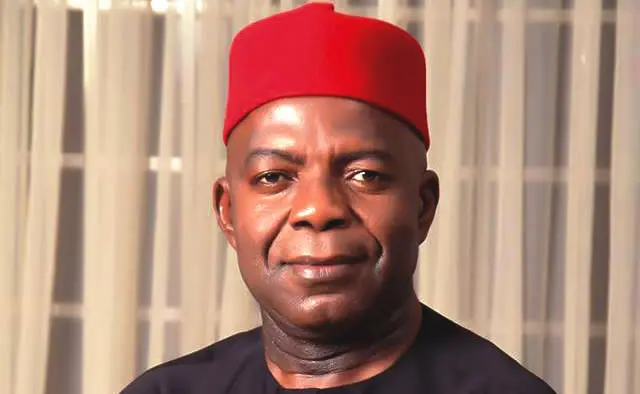
As Nigeria inches closer to the 2027 general elections, political realignments in Abia State are becoming increasingly defined by a contest between governance outcomes and political rhetoric, with Governor Alex Chioma Otti drawing a sharp moral line between his administration and former power holders.
The governor’s latest intervention came on Saturday, January 10, during a church service at the Seventh-day Adventist Church, Umuoriehi, in Umuahia North Local Government Area—a setting that lent moral weight rather than partisan colour to his remarks.
Without naming names directly, Governor Otti urged Abians to ignore what he described as renewed political gatherings by opposition figures associated with the state’s past leadership, widely linked to former governor and senator Orji Uzor Kalu, as well as other displaced political actors.
Speaking from the pulpit, the governor framed the activities of the opposition not as a credible political alternative but as a familiar regrouping driven by personal survival rather than public interest.
Drawing on biblical references from Isaiah 54:15 and Lamentations 3:37, Otti warned that not every political alliance or gathering carries moral legitimacy, insisting that words divorced from truth, accountability and performance ultimately lose relevance.
He likened the growing political noise to an “empty barrel,” arguing that those who once had the opportunity to govern Abia but failed to build enduring legacies were now attempting to rewrite history through propaganda.
Notably, the governor avoided direct political confrontation, choosing instead to focus on governance. Observers say this restraint reflects a leadership style centred on delivery rather than distraction, as his administration continues to roll out infrastructure, fiscal and institutional reforms across the state.
Supporters argue that the opposition’s renewed attacks have only strengthened public support for the governor, reinforcing comparisons between Abia’s past challenges—marked by abandoned projects, unpaid salaries and decaying infrastructure—and the reforms underway since 2023.
Central to Otti’s political confidence is the state’s ₦1 trillion-plus 2026 budget, which his administration describes as a strategic push to accelerate infrastructure renewal, strengthen human capital development and consolidate economic reforms.
Road construction, healthcare upgrades, education reforms and improvements in security architecture have become key pillars of the administration’s narrative as the 2027 elections approach.
The church event also drew attention for another reason. Governor Otti clarified that the renovation of the worship centre was funded from his personal resources, not public funds—a statement that resonated strongly in a state long shaped by debates over the misuse of government resources.
Political analysts say such gestures have helped bolster Otti’s credibility among religious leaders, civil society groups and professionals, who increasingly frame his leadership around transparency and public trust rather than political showmanship.
As Abia’s political landscape continues to evolve, the emerging consensus is that the 2027 contest will be decided less by alliances and declarations, and more by records and results.
For Governor Otti, the message appears consistent: performance, not propaganda, will determine the future—and the past, no matter how loud, may struggle to reclaim relevance in a state focused on renewal.