Now Reading: Fayose Questions Fubara’s “001” Claim, Compares Rivers Leadership to Tinubu’s Lagos Influence
-
01
Fayose Questions Fubara’s “001” Claim, Compares Rivers Leadership to Tinubu’s Lagos Influence
Fayose Questions Fubara’s “001” Claim, Compares Rivers Leadership to Tinubu’s Lagos Influence

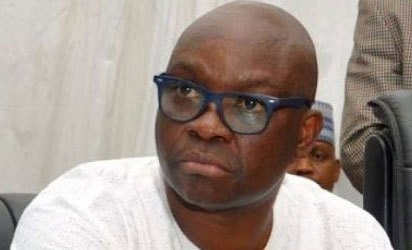
Former Ekiti State governor Ayo Fayose has challenged Rivers State Governor Siminalayi Fubara’s assertion of political leadership in the state, likening it to the situation in Lagos, where President Bola Tinubu’s influence overshadows Governor Babajide Sanwo-Olu.
Speaking during an exclusive interview on Arise TV on Tuesday, Fayose argued that Sanwo-Olu cannot claim full political authority in Lagos because the former Lagos governor, now President Tinubu, maintains overriding control. He cited the recent impeachment and reinstatement of the Lagos State House of Assembly speaker as proof of Tinubu’s dominant role.
“The president that I know hates ingratitude; he controls Lagos from the palms of his hands,” Fayose said. “For instance, the speaker was impeached, and another person took over. The president, without saying a word, caused the system to restore that speaker because it’s an affront to the president, who is the leader. Will you tell me Sanwo-Olu is the leader in Lagos?”
Fayose also described the declaration of emergency rule in Rivers State as a strategic lifeline for Governor Fubara, arguing that without it, Fubara could have faced political removal. “The emergency rule was all-winning for Governor Fubara because by now he would have been history,” he said.
The comments come amid an ongoing political feud between Fubara and his predecessor, Nyesom Wike, over the control of Rivers State’s political machinery. Fubara, who defected from the Peoples Democratic Party (PDP) to the All Progressives Congress (APC) in December 2025, publicly declared himself as the party’s “001” in the state during the flag-off of the Rivers Airport Bypass Project.
“Today, I am very happy. I am not just a member of the All Progressive Congress; I am the number one. I have collected my [membership] card, and the form is 001,” Fubara said, pledging loyalty to the ruling party and President Tinubu.
The governor’s defection followed the movement of 15 Rivers State House of Assembly members, including Speaker Martin Amaewhule, to the APC.
However, Wike dismissed Fubara’s claim, emphasizing that party registration occurs at ward and local government levels, and that leadership within the APC is not determined by executive office or membership numbering.
Fayose’s remarks highlight the contested nature of political authority in Nigerian states and raise questions about the influence of former leaders over sitting governors.