Now Reading: Man Who Killed Former Japanese Prime Minister Abe Gets Life Sentence After Homemade Gun Attack
-
01
Man Who Killed Former Japanese Prime Minister Abe Gets Life Sentence After Homemade Gun Attack
Man Who Killed Former Japanese Prime Minister Abe Gets Life Sentence After Homemade Gun Attack

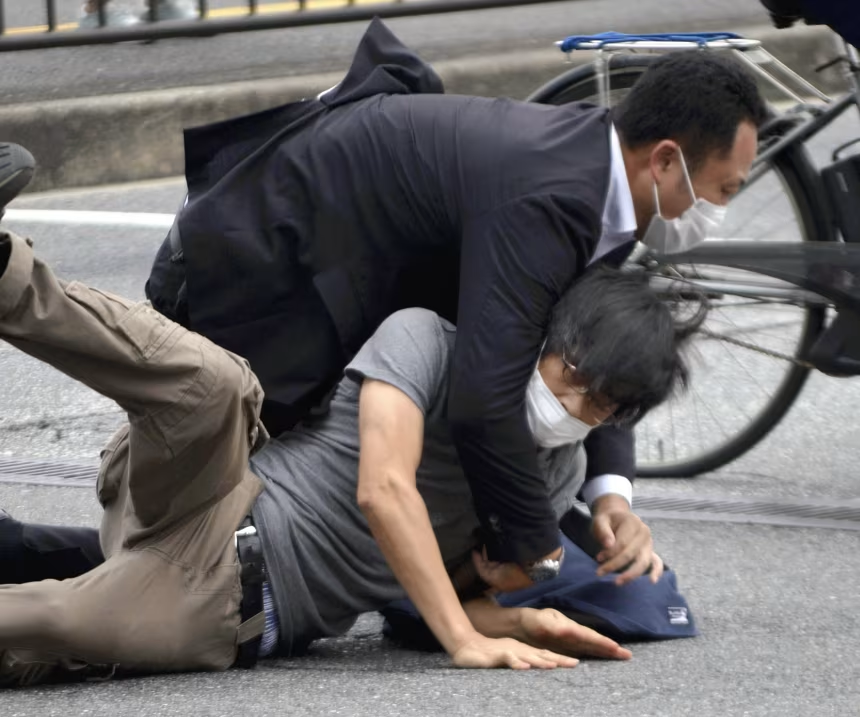
A Japanese court has sentenced Tetsuya Yamagami to life in prison for the assassination of former Prime Minister Shinzo Abe, in a case that shook Japan and revived concerns about political security and extremist influence.
The ruling, reported by public broadcaster NHK, brings closure to a trial over an attack that stunned a nation where gun violence is exceptionally rare. Abe was shot in broad daylight in 2022 while giving a campaign speech in Nara, western Japan, with a homemade firearm.
Judge Condemns Premeditated Attack
Yamagami, now 45, was arrested at the scene and later indicted on murder and firearms charges. During sentencing, Judge Shinichi Tanaka described the attack as a calculated act that targeted Abe when he was most vulnerable.
“It was a despicable act that the perpetrator waited for an opportunity, seized a moment, and targeted the victim with a gun,” the judge said.
Tanaka added that the shooting was especially heinous because it occurred in front of a crowd, causing widespread fear and trauma. He also highlighted the lasting impact on Abe’s family, noting that his widow, Akie, continues to cope with profound grief.
Abe’s Legacy and Japan’s Shock
Abe was Japan’s longest-serving prime minister, holding office from 2006 to 2007 and again from 2012 to 2020. His time in power marked a major shift in Japan’s security stance, including the passage of 2015 legislation that expanded the country’s military role in support of the United States.
Even after stepping down in 2020 for health reasons, Abe remained influential in the ruling Liberal Democratic Party (LDP) and on the global stage. He built strong ties with Washington while attempting to balance relations with Beijing, even as he pushed back against China’s regional expansion.
His killing sent shockwaves through Japan, a country known for strict gun control and one of the lowest rates of firearm crime in the world.
Political Fallout and the Unification Church Link
The assassination also renewed scrutiny of ties between the LDP and the Unification Church, a controversial religious group. Yamagami told authorities he targeted Abe because he believed the former prime minister had connections to the church, which he blamed for his family’s financial ruin due to heavy donations.
The attack triggered a wider political crisis, with the LDP facing scandals and internal divisions since Abe’s death. Japan has seen a rapid turnover of leaders, and current Prime Minister Sanae Takaichi—considered an Abe protégé—has called snap elections as she seeks to stabilise the party’s standing ahead of national polls.
A Nation Remains on Edge
The court’s life sentence marks the end of a high-profile trial, but the assassination’s political and social ripple effects continue to shape Japan’s future. The country is still grappling with the loss of one of its most influential leaders and the wider implications for security, political religion, and public trust.