Now Reading: Supreme Court to Rule on PDP, ADC Crises as Leadership Battles Threaten 2027 Opposition Strategy
-
01
Supreme Court to Rule on PDP, ADC Crises as Leadership Battles Threaten 2027 Opposition Strategy
Supreme Court to Rule on PDP, ADC Crises as Leadership Battles Threaten 2027 Opposition Strategy

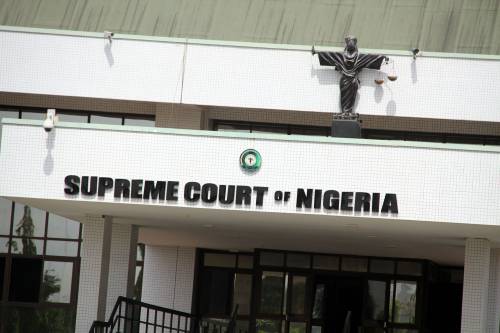
A decisive legal battle over party control reaches its peak today as Nigeria’s Supreme Court prepares to deliver judgment in two politically charged cases involving the Peoples Democratic Party (PDP) and the African Democratic Congress (ADC). The rulings could redraw the opposition map ahead of the 2027 general elections.
At the heart of both disputes lies a critical question: how far can the courts go in resolving internal party conflicts, and which faction holds legitimate authority to lead?
In the ADC case, former Senate President David Mark is asking the apex court to overturn earlier rulings that allowed a suit challenging his leadership to proceed. His legal team, led by Jibrin Okutepa (SAN), argues that party leadership disputes fall strictly within internal party affairs and should not be subject to judicial interference.
They are relying on an earlier Supreme Court precedent which held that such matters are beyond the jurisdiction of the courts, urging the justices to nullify proceedings at the Federal High Court.
However, the opposing faction, represented by Nafiu Gombe’s counsel, insists the appeal lacks merit. Their argument is simple: once constitutional or statutory breaches are alleged, the courts have both the power and the duty to intervene.
The dispute escalated after the Court of Appeal ruled against Mark, describing his appeal as premature and ordering all parties to maintain the status quo. That decision prompted the Independent National Electoral Commission (INEC) to withdraw recognition of the Mark-led leadership pending a final judicial determination.
Meanwhile, a separate but equally contentious battle is unfolding within the Peoples Democratic Party. The case stems from a controversial national convention held in Ibadan, which produced a rival leadership faction.
The group, led by Tanimu Turaki, is asking the Supreme Court to validate the convention and overturn a Court of Appeal judgment that nullified it. Their counsel argues the exercise was legitimate and should stand.
But opponents, including Sule Lamido, maintain that the convention violated a subsisting court order. Lamido had earlier secured a ruling restraining the party from proceeding until he was allowed to contest for national chairman—a directive the party ignored.
Both the Federal High Court and the Court of Appeal ruled that the PDP’s action was unlawful, stating that disobedience to a valid court order removes the protection typically granted to internal party matters.
With both cases now before the Supreme Court, the implications stretch far beyond legal technicalities. The judgments could determine which factions control party structures, influence candidate selection, and shape coalition dynamics ahead of 2027.
As political actors await the verdict, today’s rulings are expected to test not just party unity, but the broader balance between judicial authority and political autonomy in Nigeria’s democracy.