Now Reading: Opposition Firestorm Ahead of 2027: Atiku, Obi, Amaechi, Makinde Launch Parallel Presidential Bids as Tinubu Presidency Faces Unified Challenge
-
01
Opposition Firestorm Ahead of 2027: Atiku, Obi, Amaechi, Makinde Launch Parallel Presidential Bids as Tinubu Presidency Faces Unified Challenge
Opposition Firestorm Ahead of 2027: Atiku, Obi, Amaechi, Makinde Launch Parallel Presidential Bids as Tinubu Presidency Faces Unified Challenge

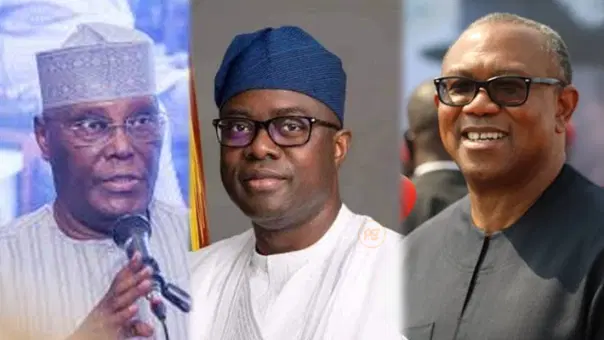
Nigeria’s 2027 presidential race has exploded into early high-stakes drama as top opposition figures formally declare ambitions, reject the status quo, and begin building competing alliances aimed squarely at unseating President Bola Tinubu.
From Abuja to Ibadan, political heavyweights including Atiku Abubakar, Peter Obi, Rotimi Amaechi and Seyi Makinde have made bold moves that signal a reshaping of Nigeria’s opposition landscape — with promises of reform, unity talks, and sharp criticism of the ruling All Progressives Congress (APC).
At the centre of the storm, former Vice-President Atiku Abubakar has formally submitted his nomination form under the African Democratic Congress (ADC), describing his campaign as a “movement to restore prosperity” and rescue Nigeria from worsening hardship. He urged citizens across regions and religions to join what he called a national rebirth project.
Peter Obi, the Labour Party’s 2023 presidential candidate now aligned with the Nigeria Democratic Congress (NDC), has reignited debate with a firm pledge to serve only one four-year term if elected. He argued that leadership discipline and power rotation are essential for national stability, insisting he would not extend his stay in office under any circumstance.
Former Rivers State Governor and ex-Minister of Transportation, Rotimi Amaechi, also threw his hat into the ring under the ADC platform. He positioned himself as the most experienced contender, warning that identity politics and “turn-by-turn” leadership culture have deepened Nigeria’s crisis. Amaechi insisted competence, not sentiment, should determine the next president.
In a separate but equally significant move, Oyo State Governor Seyi Makinde formally declared his presidential ambition under a new PDP–APM alliance. Speaking in Ibadan, he framed his candidacy as part of a broader “Reset Nigeria Movement,” calling for opposition unity and warning against what he described as creeping democratic decline and worsening economic pressure on citizens.
Makinde argued that Nigeria risks sliding toward a one-party system if opposition forces fail to coordinate. He said the alliance would field candidates across all levels of government as part of a structured push to challenge the APC in 2027.
Meanwhile, political tensions escalated further as Amaechi directly blamed the APC’s “emilokan” political philosophy for Nigeria’s current economic hardship. He said governance should be based on merit and performance, not entitlement or regional rotation narratives.
Peter Obi, in his renewed campaign messaging, compared his proposed single-term presidency to global leaders who left office after short tenures but left lasting legacies. He cited historical examples to argue that impact matters more than duration in power.
Atiku, on his part, framed the 2027 election as a defining moment for national survival, urging Nigerians to see the opposition push as a collective responsibility rather than a partisan contest. He said the goal is to restore hope and economic stability.
The emerging political alignment has also sparked reactions within opposition circles, with rival blocs and party leaders disputing claims of unity and consensus-building. Analysts say the current fragmentation could either weaken the opposition or force a last-minute mega coalition before the election.
For now, Nigeria’s political atmosphere is clearly shifting early. What began as isolated declarations is rapidly evolving into a multi-front contest — one that sets the stage for a fiercely competitive 2027 presidential election.