Now Reading: US–Taiwan Arms Debate Rekindled as Experts Question Long Delivery Delays and Carter-Era Decisions
-
01
US–Taiwan Arms Debate Rekindled as Experts Question Long Delivery Delays and Carter-Era Decisions
US–Taiwan Arms Debate Rekindled as Experts Question Long Delivery Delays and Carter-Era Decisions

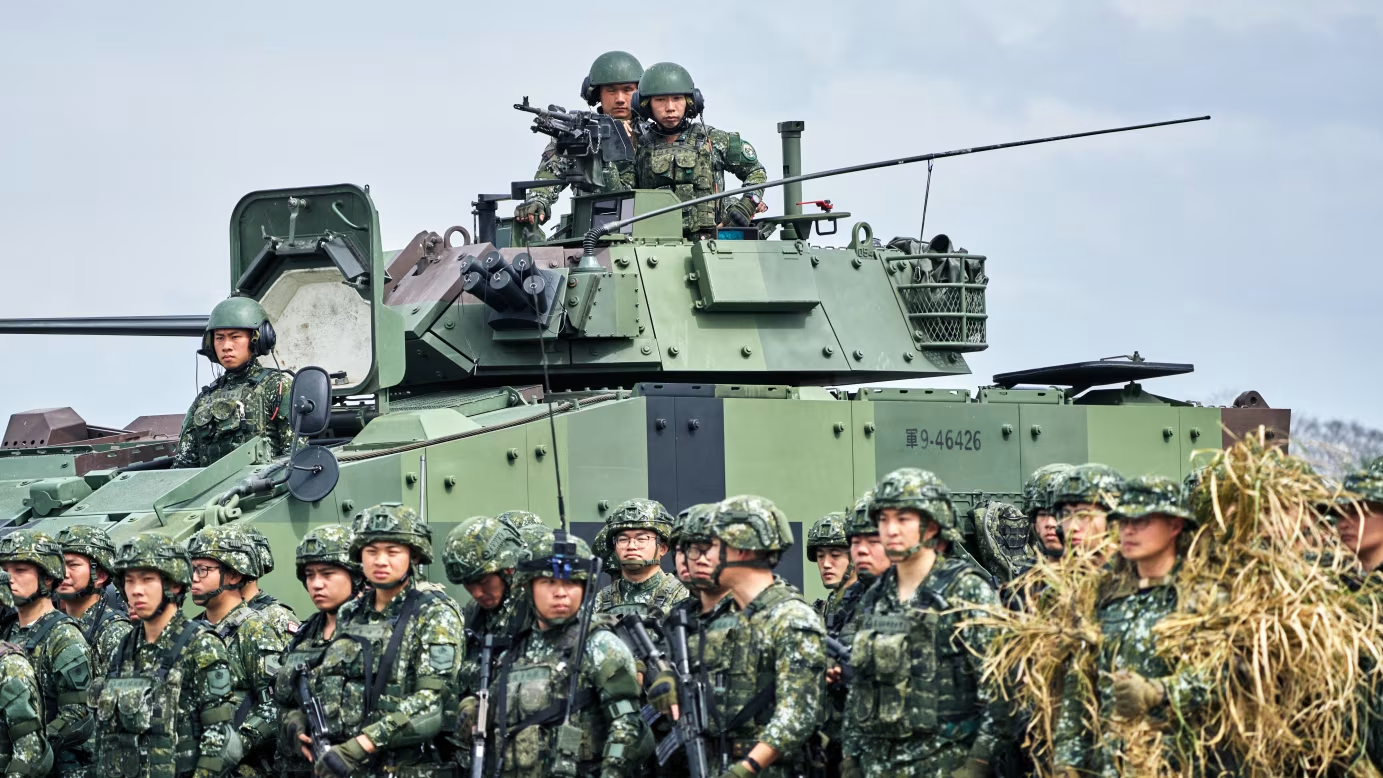
Tensions over US arms support to Taiwan are back in focus as analysts revisit decades-old diplomatic decisions and ongoing delays in weapons deliveries that critics say leave the island in a vulnerable position.
A Brookings Institution analysis has revived scrutiny of former US President Jimmy Carter’s 1979 decision to normalise relations with China, with Congress at the time reportedly describing the move as a “bad bargain.” The concern centred on Washington’s decision to end formal diplomatic ties with Taiwan and terminate the mutual defence treaty, a shift that critics argued weakened Taipei’s security posture.
Images from that period show Carter and then Chinese Vice Premier Deng Xiaoping publicly marking the historic diplomatic reset at the White House in January 1979, a moment that reshaped US–China–Taiwan relations for decades.
The Taiwan Relations Act, passed after the diplomatic break, remains the legal backbone of US policy toward Taiwan. It requires Washington to ensure Taiwan can maintain a credible self-defence capability and states that its future must be determined by peaceful means. However, interpretations of the law and related agreements continue to differ sharply between Washington and Beijing.
Beijing has long pointed to a 1982 US–China joint communiqué as evidence that Washington committed to gradually reducing arms sales to Taiwan. US officials, however, reject that interpretation, insisting there was never an agreement to end arms transfers or consult Beijing on future sales decisions.
A spokesperson for the US Department of Defense recently reiterated that Washington’s position has not changed, stating that US policy “remains unchanged” and continues to align with the Taiwan Relations Act.
Despite that stance, defence analysts say the practical reality is more complicated. Since 1979, Taiwan has purchased billions of dollars in US weapons systems ranging from fighter jets, destroyers and frigates to missile systems and logistical support. Yet delivery timelines often stretch for years.
Experts say the delays are driven by multiple factors, including production capacity constraints, competing US military priorities and shifting geopolitical conditions. Jeff Abramson, a senior fellow at the Center for International Policy, noted that arms sales are often ordered years before they are manufactured and delivered.
“It is not unusual for defense sales to take years to complete, sometimes never actually meeting full delivery,” he said, highlighting the complexity of global defence supply chains.
A recent report from the Taiwan Security Monitor project at George Mason University estimates that Taiwan is still waiting on nearly $30 billion worth of approved US weapons. In some cases, such as armoured vehicle orders, delays have stretched for more than six years.
The backlog has intensified debate in policy circles about whether the current system is capable of responding quickly enough to rising security concerns in the Indo-Pacific region, where tensions between China and Taiwan continue to shape global strategic calculations.