Now Reading: Spain Declares Three Days of Mourning After Train Collision Kills 69
-
01
Spain Declares Three Days of Mourning After Train Collision Kills 69
Spain Declares Three Days of Mourning After Train Collision Kills 69

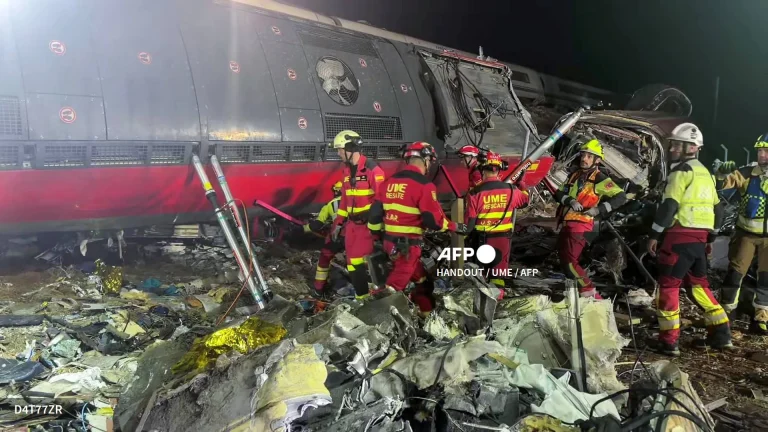
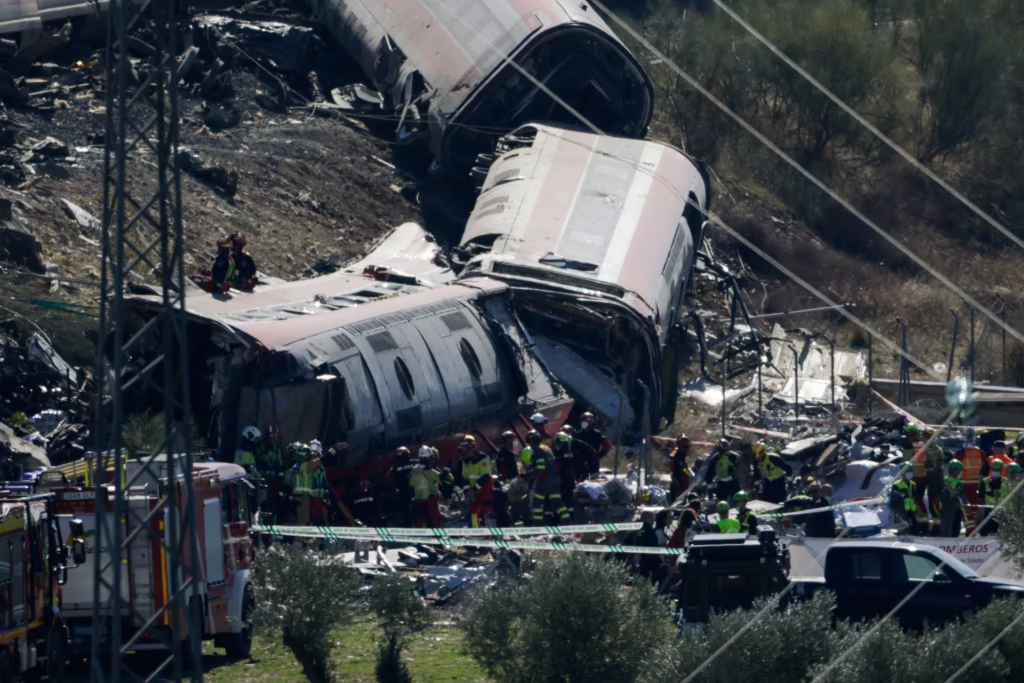
Spain has declared three days of national mourning after a high-speed train collision killed 69 people and injured scores of others, prompting renewed concerns about railway safety and leaving families desperately searching for missing loved ones.
The crash occurred on Wednesday morning in Castilla-La Mancha, central Spain, when a train operated by state-owned Renfe struck the rear of a stationary train belonging to private operator Iryo. The collision happened on a major rail route linking Madrid with the southern city of Seville.
Emergency teams continued searching the wreckage on Thursday, using cranes to move twisted metal and deploying sniffer dogs and thermal drones to locate victims. Regional authorities confirmed that the death toll had risen from 68 to 69 as the search continued near the village of Urda.
Prime Minister Pedro Sanchez visited the crash site and pledged a thorough investigation into the circumstances surrounding the disaster. Sanchez, who faces a general election on November 29, said the government was working to support victims’ families and identify measures to prevent a similar tragedy.
“We are working day and night not only to support the victims’ families, but also to establish every last detail of this tragedy and strengthen safety measures to ensure it never happens again,” he said.
Transport Minister Oscar Puente raised questions about decisions made after an automatic control system reportedly failed along 69 kilometres of track. He said the failure led to trains being stopped, but the control centre subsequently decided to resume traffic under circumstances he described as inexplicable. According to Puente, the Renfe train travelled about 25 kilometres before hitting the stationary Iryo service.
The impact left passengers trapped among damaged carriages and scattered belongings. Josimar Medina, a 31-year-old Peruvian tourist travelling with his girlfriend, said he had been asleep when the collision occurred. “I woke up, and I was in the air,” he told AFP. Another survivor, Pablo Mejia, 42, said changing seats shortly before the crash may have saved his life. “I think I’ve been born again,” he said.
Meanwhile, a school in Urda was being used as a centre where relatives could seek information about passengers. Red Cross workers and psychologists supported families dealing with shock, fear and uncertainty. King Felipe VI and Queen Letizia were also expected to visit injured passengers in a hospital in Toledo, while flags flew at half-mast and public events were cancelled or scaled back.
The disaster has renewed scrutiny of Spain’s railway network following another deadly collision in Andalusia in January, when 46 people were killed after a train derailed and crossed onto an adjacent track. That incident remains under investigation. Train drivers also began a previously scheduled strike on Thursday to demand improved rail safety as authorities continued investigating the latest crash.