Now Reading: Alex Otti’s Economic Strategy: How Abia Is Repositioning Itself as Nigeria’s Emerging Investment Hub
-
01
Alex Otti’s Economic Strategy: How Abia Is Repositioning Itself as Nigeria’s Emerging Investment Hub
Alex Otti’s Economic Strategy: How Abia Is Repositioning Itself as Nigeria’s Emerging Investment Hub

Renewed investor confidence and a push for private-sector growth are gradually reshaping the economic narrative in Abia State under the leadership of Governor Alex Chioma Otti.
Economic analysts say the shift is being driven not only by policy reforms but also by the credibility and professional reputation the governor built long before entering politics. With decades of experience in Nigeria’s financial sector, Otti has brought a governance style that places strong emphasis on fiscal discipline, strategic investment, and collaboration with the private sector.
Before becoming governor, Otti was widely known in banking and finance circles as an accomplished economist and corporate executive. His career in the financial industry, shaped by strict regulatory standards and institutional accountability, helped establish a reputation for strategic management and long-term planning.
That background is now influencing his approach to governance. Rather than viewing government as a purely administrative institution, the administration is positioning it as a catalyst for economic growth by creating conditions that encourage businesses to invest and expand.
Investor confidence grows
Observers say one of the governor’s strongest advantages is the credibility he carries into public office. In the world of finance and investment, reputation often determines whether investors are willing to commit resources.
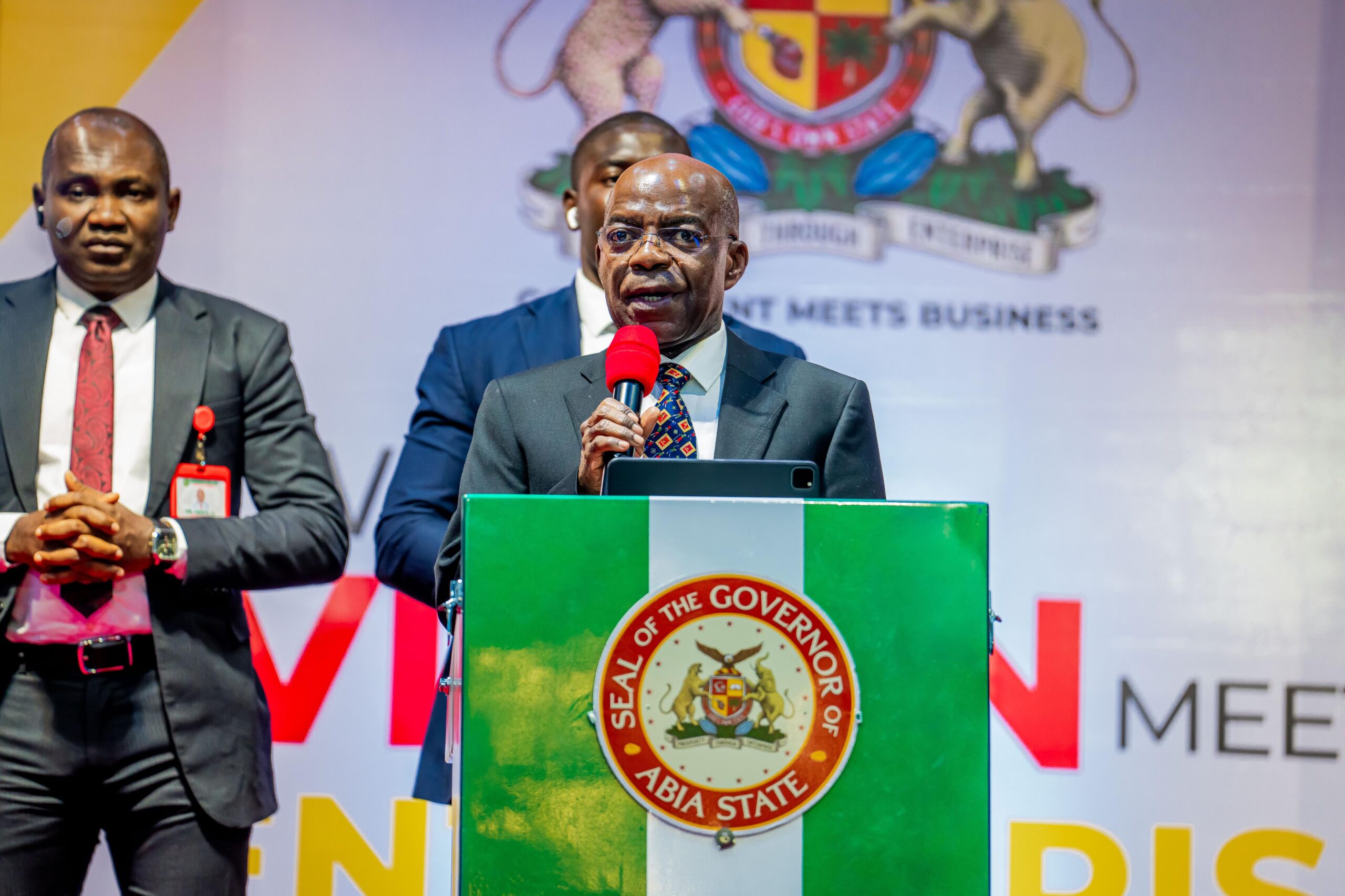
That confidence was evident during the recent Abia Business Roundtable, which brought together investors, policymakers, and industry leaders to explore investment opportunities in the state.
Speaking at the forum, Otti delivered an address titled “Opportunities, Partnership and Prosperity,” where he reaffirmed that Abia is open for business.
He highlighted several factors designed to attract investment, including favourable tax policies, improved security, a large consumer market, and a growing pool of skilled labour.
Infrastructure at the centre of economic reforms
A key element of the administration’s strategy is infrastructure development. According to the government, more than 80 percent of recent state budgets have been allocated to capital projects, particularly roads and economic infrastructure.
Major road reconstruction projects in the commercial cities of Aba and Umuahia are already reconnecting important economic corridors, improving access to markets, and easing transportation for businesses and traders.
The administration believes that restoring these critical routes will revive commercial activity in areas long affected by poor infrastructure.
Strengthening partnerships with the private sector
Efforts to attract investment have also been supported by institutional reforms, including stronger engagement with businesses through the Abia Public Private Partnership and Investment Promotion Office.
The office serves as a formal channel through which investors can collaborate with the state government on development projects.
Discussions during the business roundtable highlighted emerging opportunities across several sectors, including real estate, manufacturing, agriculture, solid minerals, hospitality, information technology, and transportation.
According to government officials, expanding these sectors could significantly increase employment opportunities and stimulate broader economic growth.
Reforms to improve ease of doing business
Beyond infrastructure, the state government has introduced regulatory reforms aimed at improving the ease of doing business.
Among the changes is the acceleration of land administration processes, particularly the issuance of Certificates of Occupancy (C-of-O), which previously suffered long delays that discouraged investors and property developers.
Officials say reducing bureaucratic bottlenecks will help encourage both local and foreign investment in the state’s property and industrial sectors.
A vision for a private-sector-driven economy
The broader economic vision of the administration is to build a dynamic economy driven largely by private-sector participation.
Government officials argue that sustainable development cannot rely solely on public spending but must be supported by strong partnerships between the state and private investors.
Through infrastructure investment, regulatory reforms, and increased engagement with businesses, the administration says it is laying the groundwork for long-term economic growth.
Analysts say that if the reforms continue to gain momentum, Abia could emerge as one of Nigeria’s most attractive investment destinations in the coming years.
The opinion was written by Ebere Uzoukwa, Senior Special Assistant to the governor on Public Affairs.