
Now Reading: CDC Panel Moves to Restrict Newborn Hepatitis B Vaccines, Prompting Fierce Backlash from Health Experts
-
01
CDC Panel Moves to Restrict Newborn Hepatitis B Vaccines, Prompting Fierce Backlash from Health Experts
CDC Panel Moves to Restrict Newborn Hepatitis B Vaccines, Prompting Fierce Backlash from Health Experts

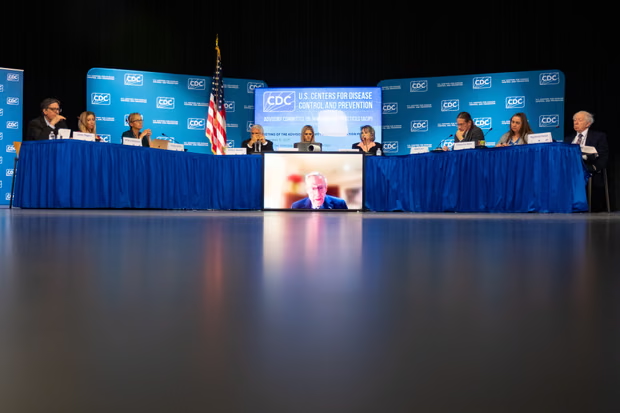
A key advisory committee to the US Centers for Disease Control and Prevention (CDC) has voted to roll back long-standing guidance that all newborns should receive the hepatitis B vaccine at birth—a shift critics say mirrors the Trump administration’s increasingly interventionist stance on vaccine policy.
The 8–3 vote by the Advisory Committee on Immunization Practices (ACIP), whose members were appointed by US Health Secretary Robert F Kennedy Jr, removes the universal birth-dose recommendation that has been in place for decades. Instead, parents of babies born to mothers who test negative for hepatitis B will now decide—together with a healthcare provider—whether and when to begin vaccination.
The term used in the recommendation, “shared clinical decision-making”, is typically reserved for non-routine vaccines and has no clear definition, leaving many doctors worried it will create uncertainty and obstruct access.
Medical and public health organisations warn the move risks reversing hard-won progress against a virus that can be fatal and is easily transmitted in everyday settings.
“This decision is going to lead to more preventable infections in children,” said Michaela Jackson, programme director of prevention policy at the Hepatitis B Foundation. The vote, she argued, “removes choice by creating barriers to access,” leaving many parents unsure whom to trust.
Under the new recommendation, infants whose mothers test positive for hepatitis B will still be vaccinated at birth. For all other newborns, the committee suggests delaying the first dose until at least two months of age if not administered immediately after delivery.
Public health officials warned that the change could disrupt routine immunisation, particularly among lower-income families who rely on the federally funded Vaccines for Children (VFC) programme, which must follow ACIP guidance. Any dilution of the birth-dose recommendation therefore risks limiting coverage for more than half of US children.
“Adding this language creates barriers to care,” said Natasha Bagdasarian, an infectious disease physician representing the Association of State and Territorial Health Officials. “Providers often interpret it as a sign the vaccine is controversial or that extra steps are required, which can deter them from offering it.”
The birth dose has been considered a cornerstone of paediatric vaccination for decades. The American Academy of Pediatrics continues to strongly recommend that every infant receive the first shot within 24 hours of birth.
The committee also recommended a blood test after the first dose to assess whether further shots are needed, despite no evidence the test can determine protection from hepatitis B or that such an approach would be effective. Some advisers warned this recommendation falls outside ACIP’s remit and could raise costs for families and insurers.
Delaying the birth dose could result in at least 1,400 additional hepatitis B infections, 300 cases of liver cancer and nearly 500 deaths annually, according to recent modelling. Liver cancer in the US carries an 18% five-year survival rate.
Most people who contract the virus never learn how they were exposed. Transmission can occur at home, in daycare centres, during sports, or through shared items such as nail clippers or earrings; the virus can remain infectious on surfaces for up to a week.
The second day of the ACIP meeting began early and quickly descended into tension. Several members objected to voting without further data.
“It is unconscionable to take a vote without adequate information,” said neurologist and adviser Joseph Hibbeln.
Cody Meissner, a leading paediatrician and the committee’s most experienced member, sharply criticised the proposals. “We know this vaccine is safe and highly effective,” he said. “If these changes go ahead, we will see more infants, adolescents and adults infected with hepatitis B.”
The recommendations now go to CDC acting director Jim O’Neill, who will decide whether to adopt them as official US policy.