Now Reading: Centre LSD Calls for 50% Women Representation in Nigerian Politics
-
01
Centre LSD Calls for 50% Women Representation in Nigerian Politics
Centre LSD Calls for 50% Women Representation in Nigerian Politics

The Centre for Legislative Support and Democracy (Centre LSD) has urged that women occupy at least half of all elective political positions in Nigeria, citing their population strength and significant contributions to society.
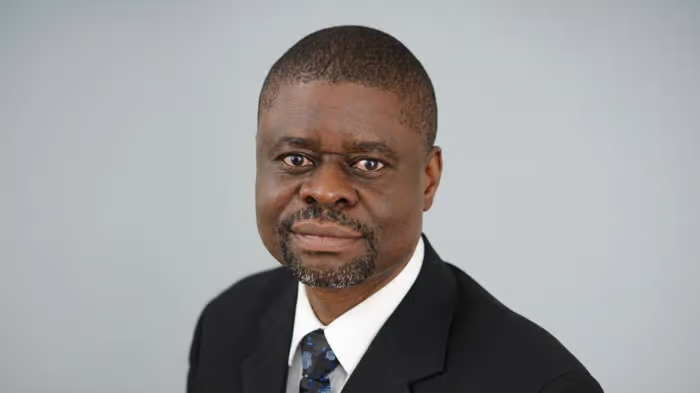
Dr. Otive Igbuzor, founder of Centre LSD and Project Director of the Male Feminists Network (MFN), made the call in Abuja during a capacity-building programme for women’s rights organisations. The initiative focused on engaging male allies to advance gender justice.
“Women constitute about half of Nigeria’s population, yet they hold only a tiny fraction of elective offices. A democracy that sidelines half of its population cannot deliver justice, stability or development,” Igbuzor said.
Addressing Misconceptions About Women’s Electoral Support
Igbuzor dismissed claims that women fail to vote for female candidates, describing the argument as “blaming the victim.”
“Youth do not automatically vote for youth either. Voting behaviour is shaped by money, power, political structures and social conditioning — not gender alone,” he explained.
He cited evidence from around the world showing that countries with higher female participation in leadership record improved development outcomes. Women leaders tend to prioritise sectors such as education, health, water, and child welfare — areas that directly enhance the quality of life.
“During the COVID-19 pandemic, countries led by women were more effective and humane in their response,” Igbuzor added.
Women Strengthen Peace and Security
The Centre LSD founder also highlighted the critical role of women in peace processes, noting that agreements are more durable when women are actively involved.
“Where women participate meaningfully in peace negotiations, agreements last longer, relapse into conflict is reduced, and communities take ownership of the peace process,” he said.
Engaging Male Allies and Promoting Accountability
Igbuzor explained that Centre LSD works closely with traditional rulers and male-dominated civil society organisations that publicly support gender equality but fail to practice it internally.
“There is a difference between proclaiming feminism and practising it. Some organisations speak gender equality but operate exclusion. That contradiction must be confronted,” he said.
Plans are underway for a national summit convened by the Male Feminists Network to bring male-dominated organisations together with women feminists to strengthen accountability and turn commitments into action.
Over 3,200 Nigerian men have been trained and certified as feminist allies under the MFN project, which focuses on preventing gender-based violence (GBV) and promoting gender equality.