Now Reading: Sudan War: UN Experts Say RSF Atrocities in El Fasher Bear ‘Hallmarks of Genocide’
-
01
Sudan War: UN Experts Say RSF Atrocities in El Fasher Bear ‘Hallmarks of Genocide’
Sudan War: UN Experts Say RSF Atrocities in El Fasher Bear ‘Hallmarks of Genocide’

Geneva — A UN-backed fact-finding mission has concluded that atrocities carried out by Sudan’s paramilitary Rapid Support Forces (RSF) in El Fasher last October show the “hallmarks of genocide”, marking one of the gravest assessments yet in Sudan’s devastating civil war.
The independent team, established by the United Nations Human Rights Council, said the RSF’s assault on non-Arab communities in and around El Fasher in Darfur involved mass killings, systematic sexual violence and conditions deliberately imposed to bring about the physical destruction of targeted ethnic groups.
The findings intensify international scrutiny of the RSF as the conflict between Sudan’s army and paramilitary forces enters its third year.
Thousands Killed During El Fasher Offensive
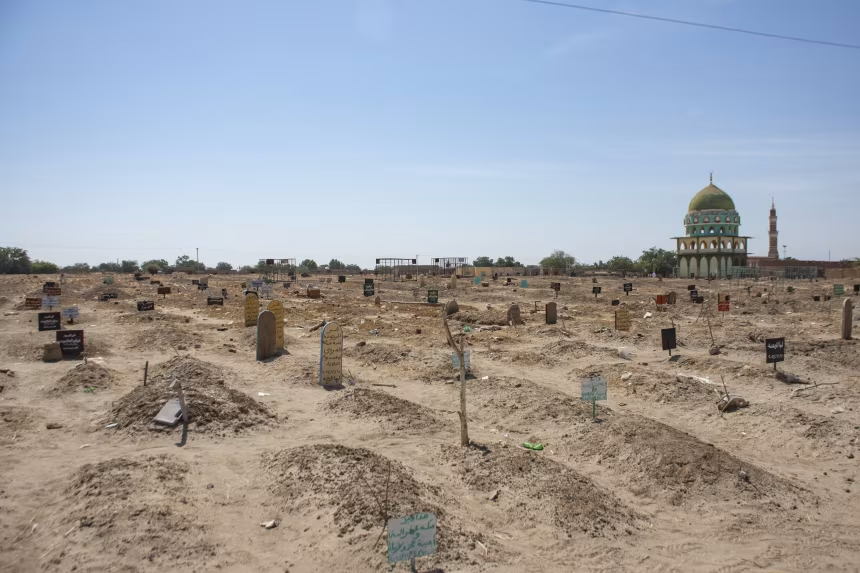
El Fasher had endured an 18-month siege before the RSF seized control of the city on 26 October. UN officials estimate that several thousand civilians were killed during the takeover, with more than 6,000 people reportedly slain between 25 and 27 October alone.
Before storming the city, RSF fighters allegedly attacked the nearby Abu Shouk displacement camp, killing at least 300 people in two days.
El Fasher, once home to about 260,000 residents, was the Sudanese army’s last major stronghold in Darfur. According to UN figures, only about 40% of the population managed to flee alive. The fate of thousands who remained is unknown.
‘Calculated Destruction’ of Ethnic Groups
The fact-finding mission said the RSF targeted non-Arab communities — particularly the Zaghawa and Fur ethnic groups — with killings, rape, torture, enforced disappearances and widespread destruction.
Investigators said they found evidence that at least three of the five criteria outlined under the 1948 Genocide Convention had been met:
- Killing members of a protected group
- Causing serious bodily or mental harm
- Deliberately inflicting conditions calculated to bring about physical destruction
Under international law, satisfying even one of these elements can constitute genocide.
The report documented survivor accounts quoting fighters as saying: “Is there anyone Zaghawa among you? If we find Zaghawa, we will kill them all,” and “We want to eliminate anything black from Darfur.”
Women and girls from Zaghawa and Fur communities were reportedly singled out for sexual violence, while those perceived to be Arab were often spared.
Mohamed Chande Othman, chair of the investigative team and former Chief Justice of Tanzania, said the operations were not random acts of wartime brutality but appeared organised and deliberate.
“Thousands of persons, particularly the Zaghawa, were killed, raped or disappeared during three days of absolute horror,” the report stated.
War That Has Devastated Sudan
Sudan descended into conflict in April 2023 after tensions between the national army and the RSF erupted into open warfare in Khartoum before spreading across the country, including Darfur.
The war has killed more than 40,000 people, according to UN estimates, though aid agencies believe the true toll may be far higher. Millions have been displaced.
Most allegations of large-scale atrocities have been levelled at the RSF, which evolved from the Janjaweed militias accused of mass killings in Darfur in the early 2000s — violence that left around 300,000 dead and displaced 2.7 million people.
The United States government, in one of its final foreign policy decisions under President Joe Biden, formally determined that the RSF had committed genocide in Darfur.
The RSF has not responded to the latest UN findings. Its commander, General Mohammed Hamdan Dagalo, has previously acknowledged abuses by fighters but disputed the scale of the allegations.
Call for Accountability as Conflict Spreads
The fact-finding mission warned that civilian protection is “needed more than ever” as the conflict expands into new regions.
It urged international accountability for those responsible, stressing that failure to act risks entrenching a cycle of impunity in Sudan.
The United Arab Emirates has been accused by UN experts and rights groups of supporting the RSF during the war — allegations the UAE denies.
As violence deepens and ethnic divisions widen, the latest findings raise fears that Darfur could once again become the epicentre of one of the world’s gravest humanitarian crises.