Now Reading: US Eliminates Two China Allies in Two Months – Beijing’s Response Remains Measured
-
01
US Eliminates Two China Allies in Two Months – Beijing’s Response Remains Measured
US Eliminates Two China Allies in Two Months – Beijing’s Response Remains Measured

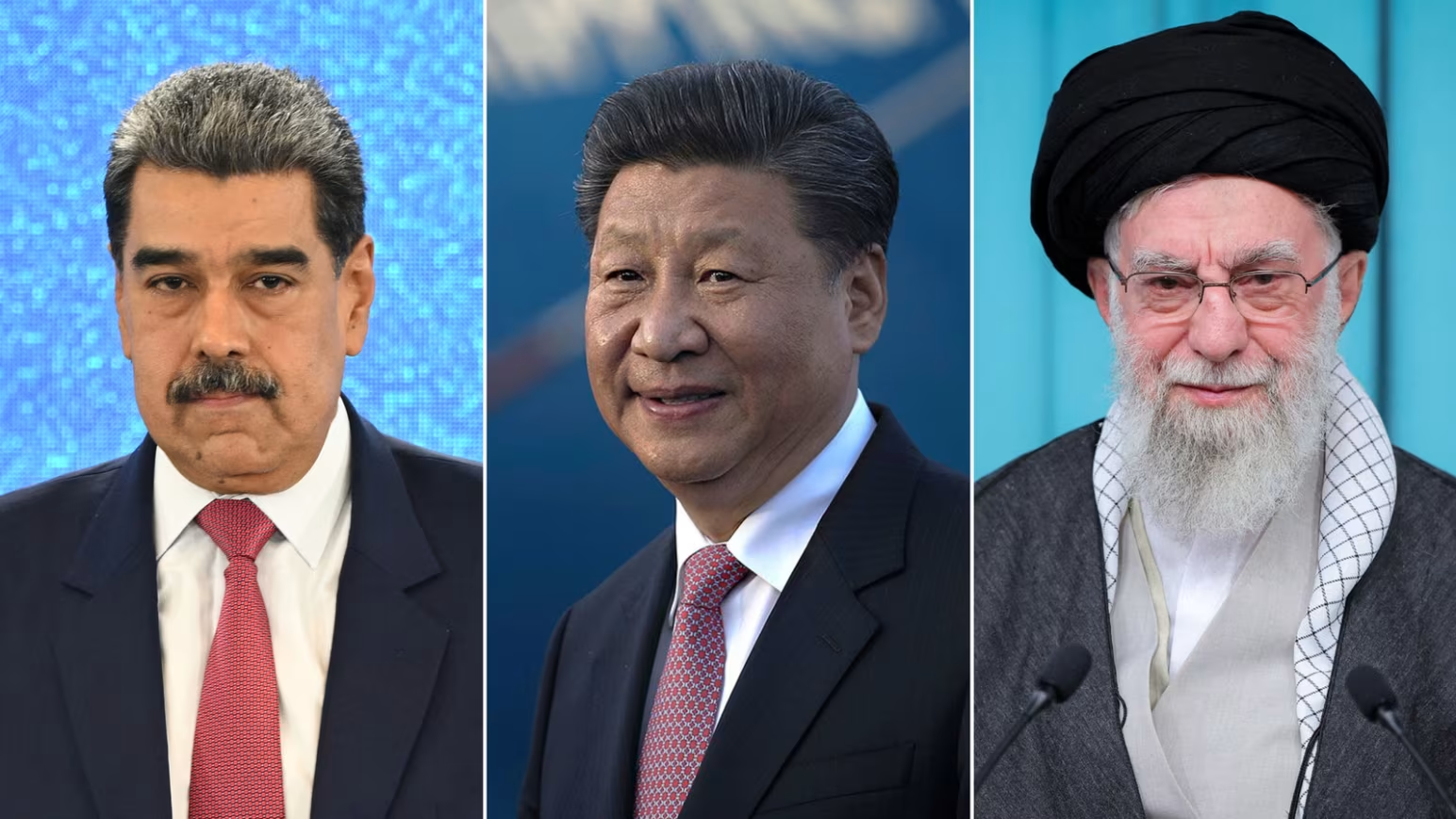
The United States has recently neutralised two key leaders traditionally aligned with China: Venezuelan President Nicolás Maduro and Iranian Supreme Leader Ali Khamenei. Maduro is now detained in New York following a dramatic raid in Caracas, while Khamenei was killed in a daylight bombing in Tehran executed by a US-Israel operation.
Despite the geopolitical shockwaves, China has primarily issued condemnations and diplomatic statements, stopping short of any direct intervention. Analysts suggest Beijing is prioritising pragmatic considerations over military or confrontational responses.
Pragmatism Over Provocation
For Chinese President Xi Jinping, immediate retaliation carries little strategic value. Iran, while an important trade partner and the largest supplier of crude oil to China, is not central to Beijing’s broader security interests. Military cooperation remains limited, and China continues to balance relations with other Middle Eastern states, including Iran’s rival, Saudi Arabia.
“China is a fair-weather friend – long on words, short on risk,” said Craig Singleton of the Washington-based Foundation for Defense of Democracies. Analysts note Beijing’s restraint reflects a deliberate approach to avoid escalating tensions with Washington, especially as US-China relations remain delicate ahead of high-level summits.
Economic Ties, Limited Security Guarantees
China has historically supported Iran diplomatically, importing the majority of its oil, opposing unilateral US sanctions, and backing Tehran’s participation in international groupings such as BRICS and the Shanghai Cooperation Organization. Chinese firms have also contributed to Iran’s missile program and surveillance infrastructure.
Yet, Beijing consistently avoids becoming a security guarantor, as seen in previous US-Iran tensions and in the limited support provided during regional conflicts. “China long avoided presenting itself as a security guarantor to Global South countries,” said William Yang, senior analyst at the International Crisis Group.
China’s restraint reflects a broader strategy: preserving energy security and regional influence while avoiding costly entanglements. The US military focus on the Middle East is also seen as an opportunity to divert Washington’s resources away from the Indo-Pacific.
Strategic Calculations and Energy Security
Iranian crude supplies account for around 13% of China’s seaborne imports. Despite the leadership changes, analysts believe China can manage short-term disruptions thanks to diversified supply lines and substantial reserves of approximately 1.2 billion barrels. However, conflicts in the Strait of Hormuz, through which a significant portion of regional oil passes, could present greater challenges.
China has also signalled its opposition to conflict escalation, urging a ceasefire while reinforcing its narrative as a non-interventionist power, contrasting US military actions with Beijing’s measured approach.
“By not providing direct security guarantees, China reduces strategic risk while maintaining flexibility,” said Zichen Wang of Beijing’s Center for China and Globalization. Analysts warn, however, that this strategy may embolden US assertiveness in regions where China’s partners are distant from its immediate sphere of influence.
Implications for Global Alliances
While the deaths of Maduro and Khamenei could destabilise US-China rival networks, Beijing’s calculated restraint underscores its focus on long-term economic and diplomatic stability rather than reactive security interventions. Even with rising US-China tensions, China continues to prioritise energy access, balanced Middle Eastern relations, and preservation of its strategic resources.