Now Reading: Uzodimma Courts Investors as Imo Targets Trillion-Dollar Economy, Unveils Bold Industrial Drive
-
01
Uzodimma Courts Investors as Imo Targets Trillion-Dollar Economy, Unveils Bold Industrial Drive
Uzodimma Courts Investors as Imo Targets Trillion-Dollar Economy, Unveils Bold Industrial Drive

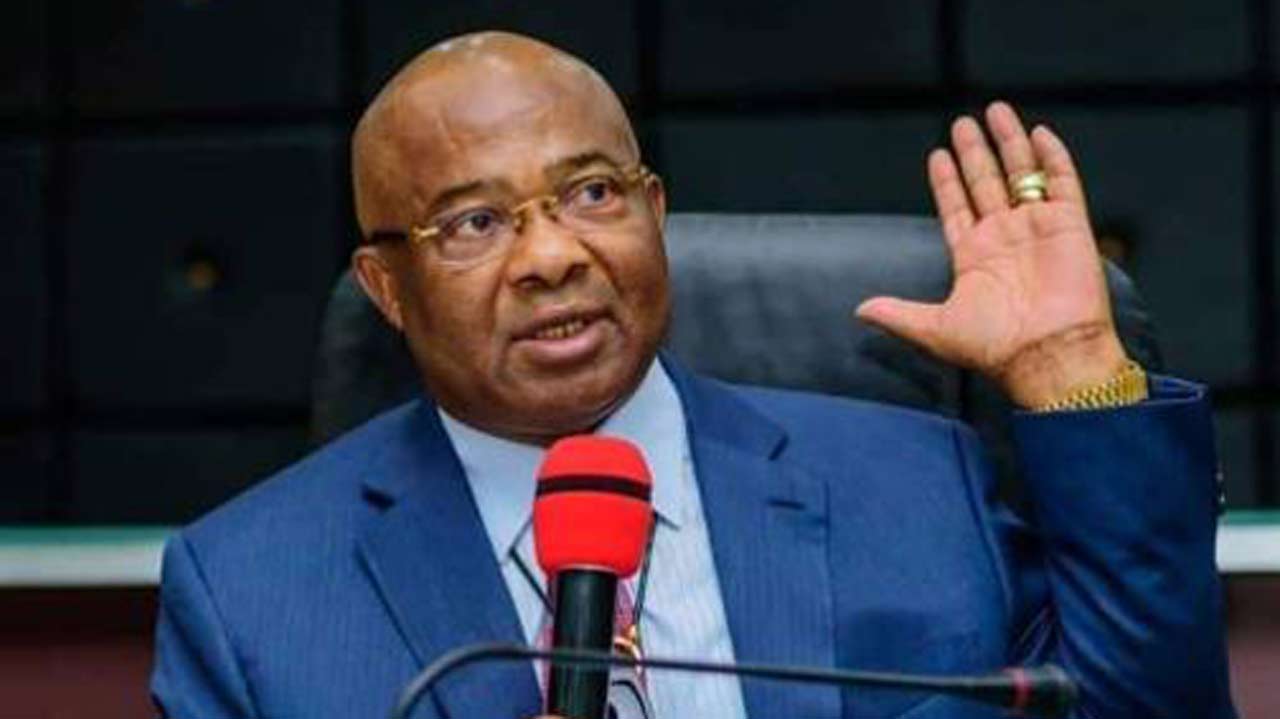
Imo State Governor, Hope Uzodimma, has stepped up his push to attract both local and foreign investors, declaring that sweeping reforms in infrastructure, power, security, and digital innovation have repositioned the state as a rising hub for business and industrial expansion in Southern Nigeria.
Speaking at the third edition of Invest Lagos 3.0, held at Eko Hotel and Suites, Victoria Island, Lagos, Uzodimma said Imo State has deliberately shifted from a government-dominated economy to a private-sector-driven model aimed at unlocking long-term growth.
He told participants at the investment summit that his administration inherited an outdated economic structure but has since reworked it to focus on enabling businesses rather than running them.
According to him, major investments in roads, security systems, and digital infrastructure have improved mobility, reduced business risks, and strengthened investor confidence across the state.
Uzodimma highlighted the Electricity Act 2023 as a turning point, noting that Imo has already taken advantage of its provisions by setting up the Imo State Electricity Regulatory Commission and launching the Orashi Electricity Company under a public-private partnership model.
He said the initiative has enabled the state to begin electricity generation and distribution, with key industrial clusters in Owerri already benefiting from improved power supply. He further disclosed plans to expand electricity access across all local government areas in phases.
On industrial development, the governor revealed that Imo has created an Energy Free Trade Zone backed by federal approval, describing it as the only hydrocarbon-based free zone in the country.
He said the zone is designed to attract gas-driven industries such as petrochemicals, fertilizer production, and energy processing plants, offering investors incentives including a 10-year tax holiday and other fiscal benefits.
Uzodimma also pointed to improvements in transport infrastructure, including the rehabilitation of Imo International Airport for cargo and passenger operations, with expanded flight capacity and international connectivity already underway.
He added that the state is exploring water transport through the development of the Orashi River corridor, which would complement road and air infrastructure and improve logistics for investors.
In addition, the governor announced that land acquisition processes have been significantly simplified, allowing investors to obtain Certificates of Occupancy within 24 hours, a move he described as key to improving the ease of doing business.
Uzodimma further showcased the Imo Digital City project, describing it as one of Africa’s most ambitious digital ecosystems. He said more than 65,000 youths have already been trained in digital skills, with a majority now employed or running businesses.
The governor also stressed that tax reforms have eliminated multiple taxation, creating a more predictable and transparent business environment aimed at boosting investor confidence.
He noted that Imo hosted a major international investment summit last year, attracting global policymakers, financial institutions, and development partners, which he said reinforced confidence in the state’s economic direction.
Looking ahead, Uzodimma said his administration has set an ambitious goal of building a one-trillion-dollar economy within the next decade, driven by partnerships with the private sector and development institutions.
He also emphasized Imo’s strategic location in the South-East, describing it as a gateway to major commercial hubs such as Onitsha, Aba, and Port Harcourt, which he said offers investors access to a large and active consumer market.
“Doing business in Imo State has never been more attractive,” the governor said, inviting investors to visit and explore opportunities firsthand.