Now Reading: Keiko Fujimori Eyes Peru Presidency Again as Political Crisis Fuels Dramatic Comeback Bid
-
01
Keiko Fujimori Eyes Peru Presidency Again as Political Crisis Fuels Dramatic Comeback Bid
Keiko Fujimori Eyes Peru Presidency Again as Political Crisis Fuels Dramatic Comeback Bid

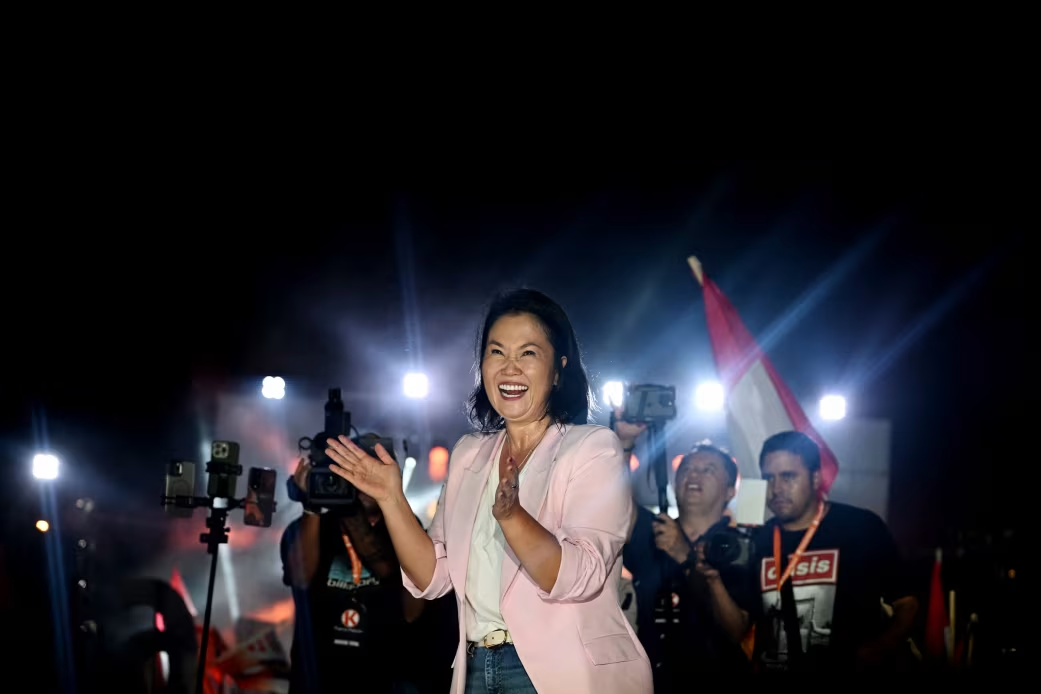
Three failed presidential bids have not stopped Keiko Fujimori from chasing Peru’s highest office again — and this time, the political winds may finally be shifting in her favor.
More than three decades after first stepping into the international spotlight as Peru’s first lady beside her father, the late former president Alberto Fujimori, Fujimori is now seeking to become president in a country exhausted by corruption scandals, economic anxiety and political instability.
At 51, the conservative leader of Fuerza Popular is contesting a runoff election against leftist rival Roberto Sánchez after losing previous presidential races in 2011, 2016 and 2021. Polls suggest she may now hold a narrow advantage.
Fujimori has built her campaign around restoring order in Peru, a country that has cycled through eight presidents in just ten years amid corruption investigations, impeachment battles and rising insecurity.
“We need order — order to live, order to invest, order to work,” Fujimori said during a presidential debate, arguing that Peruvians must choose between “chaos and disorder” or stability and economic recovery.
Her political journey began in 1994 when she replaced her mother, the late Susana Higuchi, as Peru’s first lady after family tensions exploded publicly over corruption allegations against Alberto Fujimori’s government.
Since then, Keiko Fujimori has become one of Peru’s most divisive political figures. She served as a congresswoman, founded Fuerza Popular and spent over a year in detention during a corruption probe linked to Brazilian construction giant Odebrecht. Prosecutors accused her of receiving illegal campaign funds — allegations she has repeatedly denied. A court later nullified the case in January 2025.
This election cycle, however, observers say Fujimori is presenting a different image. Rather than the confrontational tone that defined earlier campaigns, she has attempted to appear calmer, more measured and less combative.
Political analyst Julio Carrión of the University of Delaware told CNN that Fujimori appears to be distancing herself from the aggressive anti-left rhetoric that hurt her in previous elections, especially during the fiercely contested 2021 race against former president Pedro Castillo.
Still, the shadow of her father’s controversial legacy continues to follow her campaign.
Alberto Fujimori remains one of the most polarizing figures in Peru’s modern history. Supporters credit him with stabilizing Peru’s economy and defeating violent insurgent groups including the Shining Path. Critics, however, remember his government for corruption scandals and human rights abuses that later led to his conviction and imprisonment.
That legacy continues to fuel anti-Fujimori protests across Peru. Demonstrators recently marched through Lima under the slogan “Keiko no va” — meaning “Keiko won’t make it” — warning that her presidency could revive authoritarian politics.
Despite that opposition, analysts say younger voters who did not directly experience Alberto Fujimori’s presidency may be less influenced by anti-Fujimori sentiment than previous generations.
Fujimori’s opponent, Roberto Sánchez, has also struggled to generate the same level of grassroots excitement once enjoyed by Castillo during his outsider campaign in 2021. Analysts argue Sánchez has failed to establish a strong political identity capable of fully capitalizing on public frustration with Fujimori’s political bloc.
Critics also accuse Fujimori and her party of contributing to Peru’s ongoing political instability through their influence in Congress. Human rights groups and analysts have blamed lawmakers allied with Fuerza Popular for weakening institutions and fueling political chaos.
Fujimori has rejected those accusations, insisting she is not responsible for Peru’s repeated governmental crises. But as Peru heads into another defining election, the daughter of one of Latin America’s most controversial leaders remains both a symbol of resilience and one of the country’s most polarizing political figures.