Now Reading: Nigeria at 100: How Roads, Rail, Ports and Waterways Could Unlock a $1 Trillion Economy
-
01
Nigeria at 100: How Roads, Rail, Ports and Waterways Could Unlock a $1 Trillion Economy
Nigeria at 100: How Roads, Rail, Ports and Waterways Could Unlock a $1 Trillion Economy

For 100 years, Nigeria’s economic progress has depended heavily on one question: how efficiently can the country move people and goods across its vast territory? From colonial-era railways and ports to today’s standard-gauge trains, deep-sea terminals and blue-economy ambitions, transport has remained central to Nigeria’s economic story.
When The Daily Times Nigeria was launched in Lagos in 1926, railways were already extending into the hinterland, roads were linking growing settlements and ports were connecting the territory to international markets. Much of that early infrastructure was built to move agricultural produce and minerals from production centres to coastal export points, but it also created the basic transport corridors around which Nigeria’s modern economy developed.
Railways were among the earliest drivers of this transformation. The Lagos-Ibadan line, constructed between 1898 and 1901, opened a major route into the interior, while the later expansion to Kano and Maiduguri created wider links between northern production centres and the coast. By 1964, the 640-kilometre Kano-Maiduguri extension had been completed. However, decades of underinvestment and poor maintenance weakened the historic network, forcing increasing volumes of passengers and freight onto roads.
Road transport subsequently became the backbone of Nigeria’s domestic economy. The African Development Bank estimates the national road network at about 193,100 kilometres, with local governments responsible for the largest share. The Federal Roads Maintenance Agency puts the federal road network at about 36,000 kilometres. But the challenge is no longer simply building more roads. Poor maintenance increases travel times, vehicle costs and fuel consumption, while bad rural roads can prevent farmers from getting produce to markets before it deteriorates. For manufacturers and consumers, those inefficiencies eventually become higher prices.
Nigeria’s maritime sector provides the other half of the transport equation by connecting the country to global trade. Port development accelerated during the colonial period, with Apapa designated for development in 1913 and construction of its first deep-water berths beginning in 1921. Port Harcourt also emerged as a major facility after the development of coal production and the railway connection to Enugu. The Nigerian Ports Authority was later established under the 1954 Ports Act, creating a national framework for port administration.
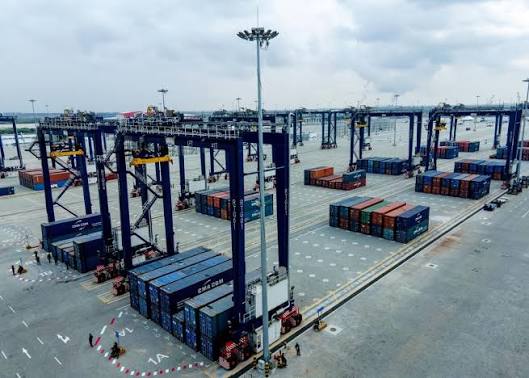
The sector has since undergone major reforms, including the port concession programme of the mid-2000s and the development of newer deep-sea infrastructure. Cargo volumes have also risen. The Nigerian Ports Authority reported that total cargo throughput increased by 24.8 per cent in 2025 to more than 129.3 million metric tonnes, compared with about 103.6 million tonnes in 2024. Container throughput had also reached 1.745 million TEUs in 2024, while export-laden containers and transhipment traffic recorded significant increases. The trend points to an opportunity for Nigerian ports to become gateways not only for imports but also for agricultural, industrial and energy exports.
That wider opportunity is now being framed around the blue economy. The Federal Ministry of Marine and Blue Economy, created in 2023, covers a broad range of activities, including shipping, ports, inland waterways, fisheries, offshore operations, shipbuilding and maritime services. Minister Adegboyega Oyetola said agencies under the ministry generated N1.83 trillion in revenue in 2025, up 160 per cent from N700.79 billion in 2023. The bigger prize, however, is not simply government revenue but ensuring that more of the value created by maritime activity is captured by Nigerian companies and workers.
Indigenous shipping remains a major test. The Coastal and Inland Shipping (Cabotage) Act of 2003 was designed to promote Nigerian participation in domestic shipping, while the Cabotage Vessel Financing Fund was established to help operators acquire vessels. Yet turning legal protection into a globally competitive Nigerian shipping industry has proved difficult because commercial shipping requires access to finance, vessels, skilled personnel, insurance, maintenance facilities and reliable cargo volumes. Similar challenges affect Nigeria’s inland waterways, despite an estimated 10,000 kilometres of waterways and more than 3,000 kilometres described as navigable.
Greater use of waterways could reduce pressure on highways by moving bulk agricultural products, construction materials, fuel and other heavy cargo more efficiently. At the same time, railway modernisation offers another route to a less road-dependent economy. Services now operate on the Lagos-Ibadan, Abuja-Kaduna and Warri-Itakpe corridors, while rail freight is being developed to connect ports with inland destinations. The real goal is not simply more trains or more waterways, but a multimodal system in which ships, railways, roads, warehouses and logistics operators work together.
Transport is already showing signs of becoming a growth industry in its own right. The National Bureau of Statistics reported that the Transportation and Storage sector grew by 7.41 per cent in real terms in the first quarter of 2026, contributing 1.02 per cent of real GDP. Logistics, trucking, warehousing, courier services, shipping, rail freight and port operations are increasingly becoming part of the productive economy rather than merely supporting other sectors.
Yet the biggest obstacle remains integration. A modern port can still become a bottleneck if containers cannot move efficiently onto roads or rail. A farmer can produce enough food but lose money because there is no reliable cold-chain system. A navigable river can remain commercially irrelevant without terminals, while a railway can underperform if industrial areas are not connected to it. Security also matters: unsafe roads, railway vandalism and maritime crime increase operating costs and can push freight towards less efficient routes.
Technology could help close some of these gaps. Digital port systems, electronic customs processes, cargo tracking, automated warehouses and integrated payment platforms can reduce delays and uncertainty. Nigeria is also exploring cleaner transport options, including LNG-powered trains and wider investments in alternative-fuel mobility.
A century after The Daily Times Nigeria began reporting on the country’s commercial life, Nigeria has many of the ingredients required for a powerful transport and maritime economy: a huge road network, expanding rail corridors, major seaports, deep-sea infrastructure, extensive waterways and a large domestic market.
The challenge now is to make those assets function as one connected economic system. Efficient transport would lower the cost of food and manufactured goods, improve access to markets, strengthen exports and make Nigerian businesses more competitive. A stronger maritime industry could create jobs in shipping, logistics, shipbuilding, offshore services and other blue-economy sectors.
Nigeria’s ambition to build a $1 trillion economy will depend not only on what the country produces, but on how efficiently those products can move from farms and factories to consumers and international markets.
The lesson of the past century is therefore straightforward: transport infrastructure is not just about roads, railways or ports. It is about productivity. The next century will test whether Nigeria can finally connect those pieces into a system capable of powering sustained economic growth.