Now Reading: Tinubu Defends Economic Reforms, Says Nigeria Is Rewriting Its Story of Underperformance
-
01
Tinubu Defends Economic Reforms, Says Nigeria Is Rewriting Its Story of Underperformance
Tinubu Defends Economic Reforms, Says Nigeria Is Rewriting Its Story of Underperformance

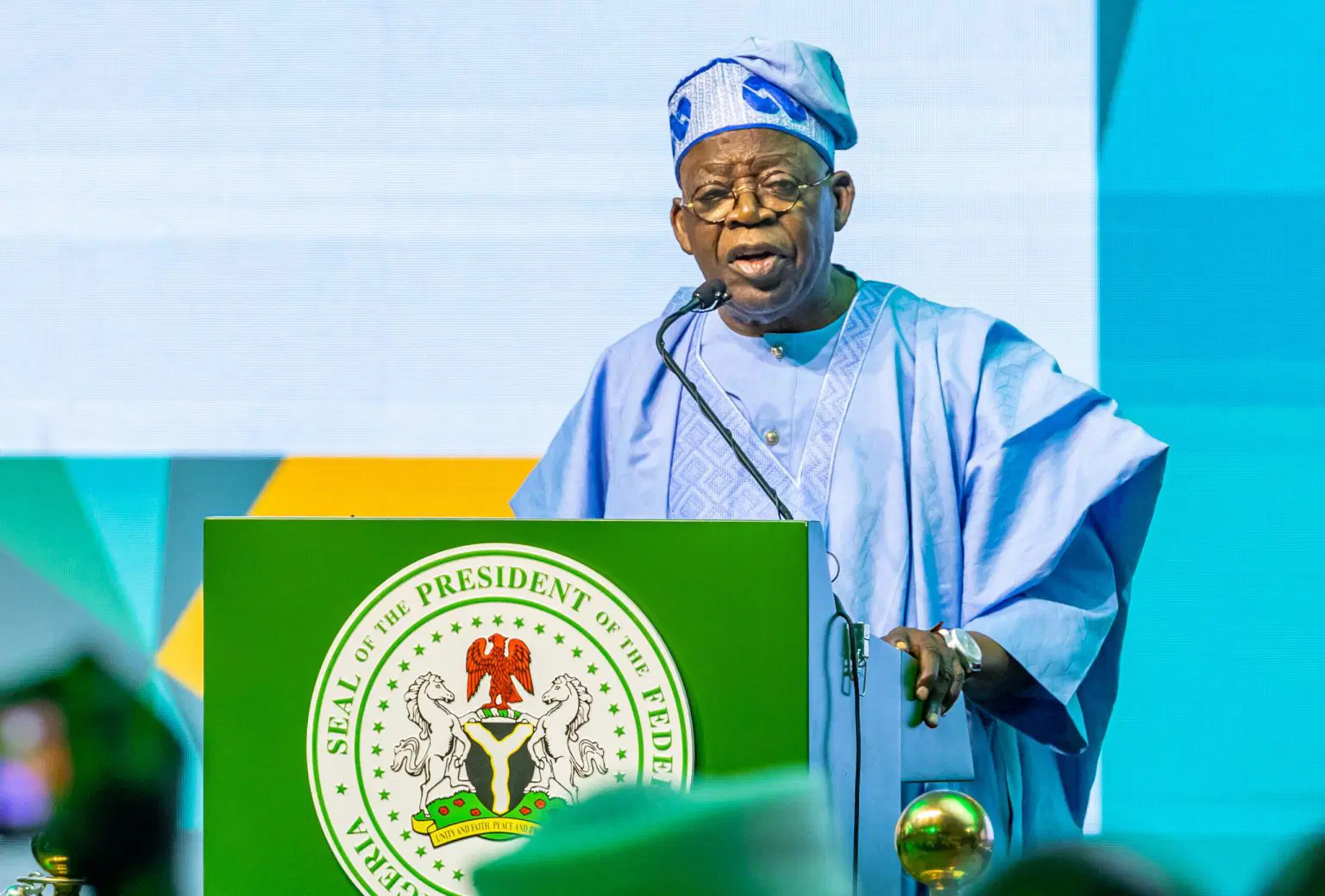
President Bola Tinubu has defended his administration’s economic reforms, saying they are laying the foundation for job creation, higher productivity and shared prosperity as Nigeria seeks to overcome decades of economic underperformance.
Tinubu made the remarks on Monday through Vice-President Kashim Shettima, who represented him at the opening of the 32nd Nigerian Economic Summit Group (NESG) summit in Abuja. He acknowledged that the administration began with difficult economic adjustments but insisted that lasting growth required stabilising the economy and creating conditions for businesses to expand.
“We came to rewrite the story of a nation that has performed below its potential for far too long. But there is no shortcut to economic growth,” the President said. He added that economic recovery must improve the livelihoods of job seekers, farmers, manufacturers, entrepreneurs and innovators, rather than focus solely on headline economic figures.
Speaking under the summit theme, “Growth That Works: Delivering Jobs, Productivity and Shared Prosperity,” Tinubu said his government had introduced reforms intended to remove structural barriers to growth, restore investor confidence and encourage greater private-sector investment. He also stressed that job creation must be accompanied by better-quality employment, reduced underemployment and improved productivity across the economy.
Citing figures from the National Bureau of Statistics, the President said Nigeria’s inflation-adjusted gross domestic product grew by 3.89 per cent in the first quarter of 2026, compared with 3.13 per cent in the same period of 2025. He added that non-oil activities accounted for 96.08 per cent of GDP, while manufacturing grew by 3.29 per cent and the oil sector by 2.57 per cent.
Tinubu also reported that capital importation reached $10.37 billion in the first quarter of 2026, representing an 83.83 per cent increase from the corresponding period in 2025. He said the government would continue efforts to simplify regulations, improve transparency, make policies more predictable and widen access to finance. Other priorities include electricity-market reform, agricultural mechanisation, irrigation, rural infrastructure and greater domestic processing of solid minerals.
United Nations Deputy Secretary-General Amina Mohammed acknowledged the gains from the administration’s reforms but called for urgent consolidation and economic stabilisation. She also urged the government to manage expectations among citizens and other stakeholders, while commending the African Development Bank for prioritising development financing with measurable impact.
Finance Minister Taiwo Oyedele presented a proposed Nigerian Economic Policy Framework, which he described as a national guide for economic decision-making and measuring progress. He invited the NESG and private-sector experts to scrutinise the draft using evidence and data. The proposed framework focuses on economic stability, human capital development, productivity, enterprise and fair markets.
NESG Chairman Olaniyi Yusuf said the summit offered stakeholders an opportunity to contribute to inclusive economic growth. He argued that the priority should be to stabilise the economy following the structural changes introduced by the government, rather than reverse the reforms. BUA Group Chairman AbdulSamad Rabiu also backed the policy direction, saying improved access to foreign exchange had made the business environment more predictable, despite the continuing difficulties faced by ordinary Nigerians.