Now Reading: UNILORIN Shutdown Deepens as SSANU, NASU Demand 45% Pay Rise and Full 2009 Agreement
-
01
UNILORIN Shutdown Deepens as SSANU, NASU Demand 45% Pay Rise and Full 2009 Agreement
UNILORIN Shutdown Deepens as SSANU, NASU Demand 45% Pay Rise and Full 2009 Agreement

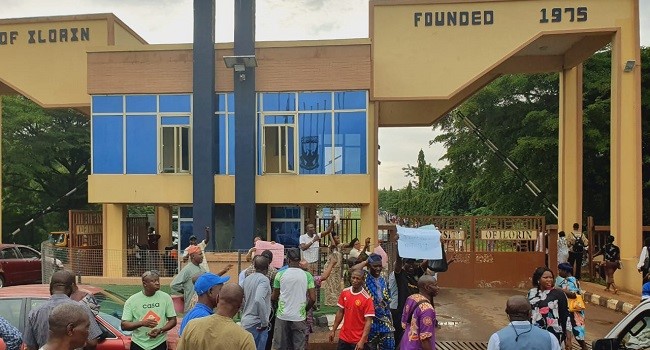
A full-blown shutdown has hit the University of Ilorin (UNILORIN) as non-teaching staff escalate their nationwide indefinite strike, insisting on a 45 per cent salary increase and complete implementation of the 2009 agreement.
What started as another labour dispute has now crippled core operations on campus. Members of the Senior Staff Association of Nigerian Universities (SSANU) and the Non-Academic Staff Union (NASU) flooded the university gate in protest, brandishing placards and withdrawing essential services across departments that keep the institution running.
This isn’t symbolic action—it’s operational paralysis. Administrative offices are inactive, transport services have stopped, and the daily rhythm of campus life has been disrupted.
At the heart of the dispute is a hard-line position from the unions: they have rejected the Federal Government’s proposed 30 per cent salary increase and are holding firm at 45 per cent. Falowo Olushola made that stance clear.
“Basically today, our demand is the conclusion, signing and implementation of the 2009 agreement. We reject the 30% that was proposed to us outrightly… our demand is 45% and that is final,” he said.
Behind that demand is years of unresolved negotiations. Union leaders say the government has repeatedly delayed action despite multiple ultimatums. A deadline issued in March expired on May 1 with no concrete outcome, fueling frustration among workers.
Olushola stressed that the strike is not a warning but a total withdrawal of services, pointing out that non-teaching staff handle critical functions such as security, ICT, finance, and transportation—roles that directly sustain university operations.
The frustration runs deeper than salaries. Suberu Haruna Ibrahim said the renegotiation of the 2009 agreement has dragged on since 2017 without resolution, leaving non-academic staff feeling sidelined.
“This renegotiation has been on since 2017, yet the government has not concluded the non-teaching staff component. We cannot continue like this,” he said.
He also highlighted what unions see as unequal treatment, noting that academic staff reportedly received around a 40 per cent pay increase earlier this year, while non-teaching workers were excluded. The unions are demanding parity—and backdated payments.
Beyond wages, unresolved arrears remain a major sticking point. Ibrahim said outstanding salaries from 2022, spanning over a year, are yet to be cleared, adding to the growing tension.
The real leverage, however, is impact. With drivers off duty and essential services halted, students are already feeling the strain—many now trekking across campus as transport systems shut down.
The unions insist the disruption is deliberate. Their calculation is simple: until the system feels the pressure, nothing will change. And for now, they are prepared to hold the line indefinitely.