Now Reading: US Pressure Forces Latin American Nations to Cut Cuban Medical Missions, Leaving Rural Patients in Crisis
-
01
US Pressure Forces Latin American Nations to Cut Cuban Medical Missions, Leaving Rural Patients in Crisis
US Pressure Forces Latin American Nations to Cut Cuban Medical Missions, Leaving Rural Patients in Crisis

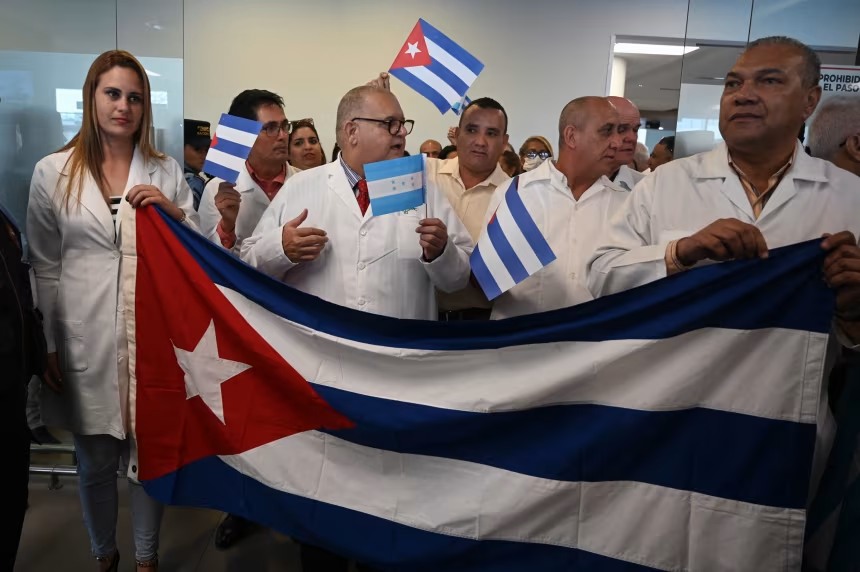
A quiet clinic in rural Honduras once offered the only affordable eye care for thousands. Today, it stands empty — a symbol of a wider political storm tearing through Latin America’s public health systems as governments shut down Cuban medical missions under mounting US pressure.
The cancellation of Honduras’ “Mission Miracle” programme has left patients like Hector Zelaya stranded mid-treatment. The Cuban-backed initiative had provided cataract surgeries and other essential eye care in remote regions where private healthcare remains out of reach for most residents.
Zelaya, who was scheduled for surgery in April, saw his operation abruptly cancelled after the Honduran government terminated its contract with the Cuban medical programme in March. What followed was a scramble that forced him to pay $2,250 at a private clinic — a cost far beyond what many locals can afford.
The policy shift came under President Nasry “Tito” Asfura, a conservative leader backed in last year’s election by US President Donald Trump. His administration argued that Cuba’s deployment of doctors and nurses did not comply with local regulations, effectively ending one of the country’s most accessible healthcare pipelines.
Honduras is not alone. Across the Americas, countries including Jamaica, Guyana, Guatemala and Venezuela have either cancelled or are reviewing similar agreements with Cuba’s medical missions — a programme that has been central to Havana’s foreign policy and a major source of revenue for decades.
The Cuban government has strongly criticised the wave of cancellations, accusing Washington of driving what it calls a coordinated political campaign. US officials, however, argue the programme exploits medical workers and has pushed for restrictions on countries and officials involved in hosting Cuban medical teams.
US Secretary of State Marco Rubio has been one of the most vocal critics, announcing visa restrictions targeting officials linked to the Cuban programme. Washington says the initiative relies on coercive labour practices, a claim Cuba denies.
A recent report by the Inter-American Commission on Human Rights acknowledged the programme’s role in improving healthcare access in underserved areas but also raised concerns about working conditions for Cuban medical staff, including limited freedoms and political pressure.
For rural communities, the policy shift is already being felt. In Catacamas, Honduras, where the abandoned clinic sits on the outskirts of a bushy hillside town, residents say options for affordable eye surgery have effectively vanished.
The average monthly income in much of Honduras ranges between $400 and $800, making private treatment unattainable for many families. For patients like Zelaya, the loss of the Cuban programme has turned treatable conditions into life-altering setbacks.
As more countries reconsider their agreements, critics warn that geopolitics is colliding directly with healthcare access. Supporters of the Cuban missions argue they fill critical gaps in under-resourced health systems, while opponents insist the programmes must be restructured over ethical concerns.
For now, patients caught in the middle are paying the price — in both money and delayed care.