Now Reading: Kyari Warns Politicians Against Using 33.5 Million Food Insecurity Projection for 2027 Campaigns
-
01
Kyari Warns Politicians Against Using 33.5 Million Food Insecurity Projection for 2027 Campaigns
Kyari Warns Politicians Against Using 33.5 Million Food Insecurity Projection for 2027 Campaigns

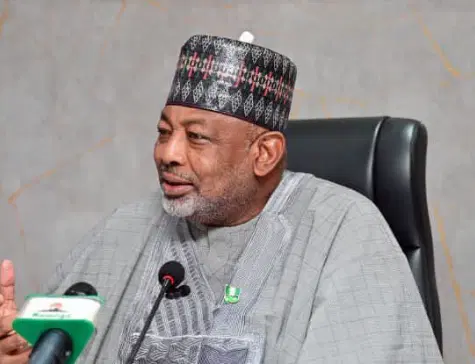
The Minister of Agriculture and Food Security, Senator Abubakar Kyari, has cautioned opposition politicians against using the October 2026 Cadre Harmonisé food security assessment as a tool for political campaigns ahead of the 2027 general elections.
Kyari, in a statement on Monday, said the projection that 33.5 million Nigerians could face severe food and nutrition insecurity between June and August 2027 should not be interpreted as an assessment of the performance or electoral prospects of any political administration.
He described attempts to link the projection to President Bola Tinubu’s re-election bid as a misrepresentation of the technical assessment, insisting that it was designed to identify food security risks rather than serve as an election forecast.
The minister explained that the Cadre Harmonisé was developed by the Permanent Inter-State Committee for Drought Control in the Sahel (CILSS), working with regional and technical partners, to assess food and nutrition insecurity and help governments and development organisations plan early interventions.
The assessment is supported by organisations including the Food and Agriculture Organisation (FAO), World Food Programme (WFP), FEWS NET, UNICEF and the Integrated Food Security Phase Classification (IPC).
According to Kyari, the projected 33.5 million people represent a decline from the 34.8 million estimated for the corresponding period in 2026. However, he acknowledged that the assessment does not conduct a retrospective review after the projected period to determine whether the forecasts were accurate.
He identified climate change, irregular rainfall, prolonged dry spells and disruptions to weather patterns associated with the Super El Niño phenomenon as factors contributing to food insecurity. These challenges, he said, have affected planting seasons and crop production, particularly among farmers who depend on rainfall.
Kyari also maintained that the assessment did not attribute the projected figures to the continuation of any particular political administration.
On the Federal Government’s response, he listed expanded access to fertilisers and other agricultural inputs, mechanisation, irrigation, dry-season farming, improved agricultural financing and investments in storage, processing and climate-resilient agriculture as key interventions.
The minister further highlighted improved security in some farming communities, saying it had enabled farmers who previously could not access their land to resume cultivation. He cited Marte and Guzamala in Borno State as areas where improved stability had allowed data collectors to conduct the assessment after earlier security challenges restricted access.
Other interventions highlighted by Kyari include fertiliser distribution and local blending, support for smallholder farmers, mechanisation partnerships, expanded dry-season farming and improved access to agricultural financing through the Bank of Agriculture.
He admitted that the measures would not eliminate Nigeria’s food insecurity challenges immediately, describing the problem as a longstanding structural issue that predates the current administration.
“Food insecurity is a longstanding and structural challenge that has developed over many years and predates this administration,” he said.
The minister nevertheless maintained that the agricultural sector had recorded progress since Tinubu assumed office, adding that the government remained committed to increasing food production and strengthening national food supply systems.
“As Minister, I accept the responsibility that comes with this challenge. When the data identifies a risk, our duty is to act on it, not to hide from it,” Kyari said.
He urged political actors to exercise caution when discussing food security statistics, warning against turning the welfare and livelihoods of millions of Nigerians into political talking points.
Kyari said the government welcomed scrutiny and constructive criticism but insisted that technical assessments should not be deliberately misrepresented for electoral purposes. He added that the findings would guide further interventions to support farmers, protect livelihoods and improve access to safe, nutritious and affordable food.