
Now Reading: NGX Manufacturers’ Inventories Hit N1.77tn as Production Costs Rise
-
01
NGX Manufacturers’ Inventories Hit N1.77tn as Production Costs Rise

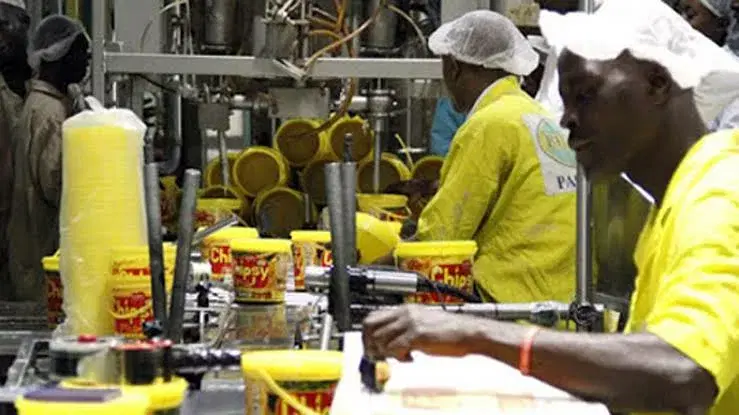
Manufacturing companies listed on the Nigerian Exchange Limited (NGX) entered the second quarter of 2026 with combined inventories of about N1.77 trillion, as rising production costs and weak consumer purchasing power continued to put pressure on businesses.
Financial Vanguard findings showed that the companies’ combined inventories increased by 10.6 per cent year-on-year, from N1.597 trillion in the corresponding period, while their combined cost of sales rose by 13.7 per cent from N1.261 trillion to N1.434 trillion.
The figures suggest that manufacturers are holding more unsold goods while spending significantly more to produce and distribute their products. The trend cuts across consumer goods, building materials, agriculture, food processing and other manufacturing-related sectors.
Dangote Cement recorded the largest inventory position at N703.58 billion, up 4.8 per cent from N671.55 billion. UACN recorded one of the sharpest increases, with inventory rising by 231.8 per cent to N189.55 billion.
Okomu Oil Palm’s inventory increased by 90.3 per cent to N39.90 billion, while Livestock Feeds rose by 35.9 per cent to N9.14 billion. PZ Cussons recorded a 29.7 per cent increase to N69.37 billion, while Beta Glass and Vitafoam rose by 28.8 per cent and 12.3 per cent respectively.
Some manufacturers, however, recorded declines. Northern Nigeria Flour Mills’ inventory fell by 34.6 per cent to N31.46 billion, while NASCON Allied Industries dropped by 17.1 per cent to N14.34 billion. Cadbury Nigeria, Unilever Nigeria, Nestlé Nigeria and Nigerian Breweries also recorded inventory declines.
The pressure was more pronounced in cost of sales, which increased faster than inventories. Dangote Cement’s cost of sales rose by 10.2 per cent to N448.73 billion, while Nigerian Breweries recorded N233.16 billion and Nestlé Nigeria N194.07 billion. UACN recorded the largest percentage increase, with cost of sales jumping 226.8 per cent to N136.41 billion.
President of the Chartered Institute of Stockbrokers, Fiona Ahimie, attributed the inventory build-up to both supply and demand factors. She said manufacturers had increased production capacity as operating conditions and access to foreign exchange improved, but consumer demand had not grown at the same pace because prices remained high relative to household incomes.
Ahimie also identified energy, transportation, logistics, raw material and financing costs as major pressures on manufacturers. She called for improved electricity and transport infrastructure, policy consistency and affordable financing, alongside measures to boost employment, real incomes and purchasing power.
David Adonri, Managing Director of Highcap Securities Limited, linked the accumulation of unsold goods partly to inflation and declining consumer purchasing power. He also cited higher energy and distribution costs, insecurity and disruptions to domestic raw material supplies as factors affecting production.
Olatunde Amolegbe, Managing Director of Arthur Steven Asset Management Limited, said the inventory increase reflected both demand and supply pressures. Although inflation had fallen from its 2024 peak, he said the effects of previous price increases continued to weaken household purchasing power, while high interest rates were constraining consumption, inventory financing and business expansion.
Amolegbe urged the government to improve electricity, transportation and logistics infrastructure, expand access to affordable financing and support local sourcing of raw materials. He also recommended backward integration and targeted fiscal incentives to improve the competitiveness of Nigerian manufacturers