Now Reading: How a Viking King Gave His Name to Bluetooth
-
01
How a Viking King Gave His Name to Bluetooth

More than 1,000 years before smartphones, wireless headphones and laptops began connecting through Bluetooth, a Viking king in Denmark was building a reputation as a powerful unifier.
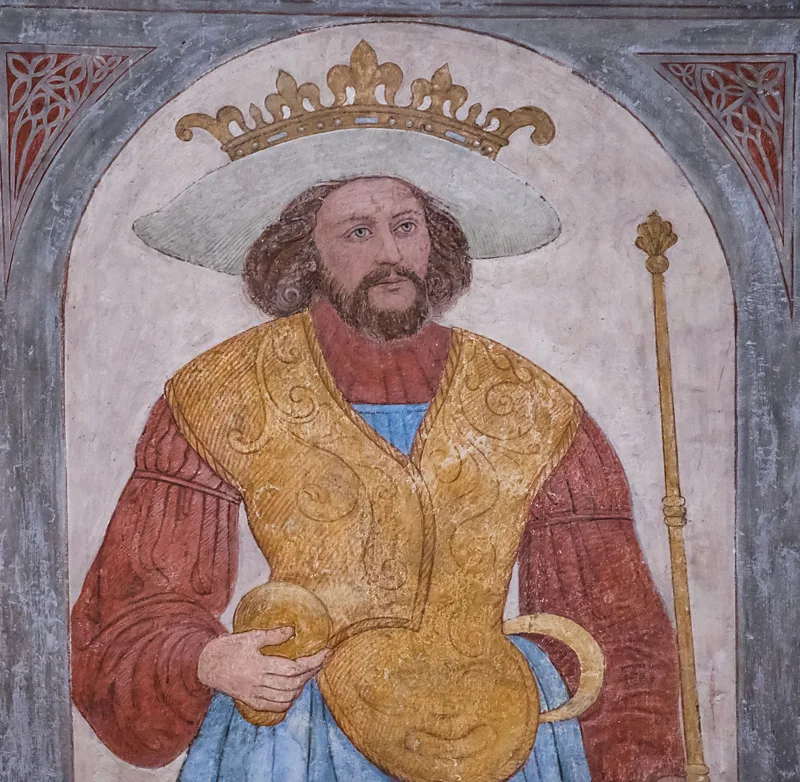
His name was Harald Gormsson, better known as Harald Bluetooth, a 10th-Century ruler whose legacy remains visible in the Danish town of Jelling.
Today, Jelling’s ancient runestones tell the story of Harald’s reign, including his role in Denmark’s transition from pagan Viking rule to a Christian kingdom.
But the king’s influence did not end with the Viking Age. More than a millennium later, his unusual nickname became the inspiration for one of the world’s most widely used wireless technologies.
The Viking king behind the name
Harald Gormsson ruled Denmark during the 10th Century. His nickname, Bluetooth — Blátǫnn in Old Norse — was first documented around 150 years after his death.
Historians believe the name may have referred to a blue or damaged tooth, although its exact origin remains uncertain.
One of Harald’s most significant achievements was Denmark’s conversion to Christianity, believed to have taken place around 965.
The larger of the two Jelling runestones, commissioned by Harald, declares that he won Denmark and Norway and converted the Danes to Christianity. It also features one of the earliest known depictions of Christ in Scandinavia.
The adoption of Christianity helped Harald strengthen Denmark’s links with the wider Christian world while consolidating his political authority.
Adam Bak, a curator at the Kongernes Jelling Experience Center and Museum, described the period as a crucial stage in the development of the Danish state.
He said the transition involved learning new political systems and understanding how Christianity could help centralise power.
Why Jelling is important to Denmark
Harald’s story is deeply connected to Jelling, which was a major centre of power during his reign.
The town’s older, smaller runestone was commissioned by Harald’s father, Gorm, in memory of his wife, Thyra. It is believed to contain the earliest written reference to Denmark found within the country.
The site has consequently been described as Denmark’s “birth certificate”.
Although Jelling has only about 4,000 residents today, it was an important political and religious centre more than 1,000 years ago.
The area originally served as a pagan burial site before becoming a place where pagan and Christian traditions existed side by side during Harald’s reign.
Today, the Jelling landscape includes burial mounds, a church and the two famous runestones. Markers also trace the outline of a huge ship-shaped enclosure that once surrounded the monuments.
The site became Denmark’s first UNESCO World Heritage site in 1994.
At the nearby Kongernes Jelling visitor centre, exhibitions explore the transformation of Viking society and the arrival of Christianity.
How Harald became Bluetooth
Harald’s reputation as a ruler who brought different territories and peoples together eventually caught the attention of engineers working on a very different kind of unification.
In the late 1990s, engineers from companies including Intel, Ericsson, Nokia, IBM and Toshiba were developing a technology designed to allow electronic devices made by different companies to communicate with one another.
They needed a temporary codename.
Intel engineer Jim Kardach was working with Swedish engineers at the time and became interested in Viking history. He read about Harald Bluetooth and his efforts to unite Denmark and Norway.
The comparison seemed appropriate: just as Harald had helped bring different territories together, the new technology was intended to connect different devices.
The codename Bluetooth eventually leaked before the technology’s official launch.
Despite concerns from public relations teams that the name did not explain what the technology actually did, it survived.
Adam Bak said the distinctive name ultimately helped the technology stand out from more descriptive alternatives.
The meaning behind the Bluetooth logo
The connection to Harald Bluetooth goes beyond the name.
The familiar Bluetooth logo is made by combining two Norse runes representing Harald’s initials — H and B.
The symbol has since become one of the most recognisable technology logos in the world.
In 2023, marking the 25th anniversary of Bluetooth technology, Kardach and other people involved in its development travelled to Kongernes Jelling.
They jokingly “apologised” for using Harald’s name without permission.
The museum accepted the apology and, in a playful gesture, gave them permission to continue using the name for another 1,000 years.
For a Viking king whose legacy was built around bringing people and territories together, the modern use of his name is remarkably fitting.
“Harald loved showing off,” Bak said. “I think he would be very happy to know that billions of people say his name on a daily basis today.”