Now Reading: Nepal Floods: Experts Explain How Glacial Collapse Triggered Deadly Landslides
-
01
Nepal Floods: Experts Explain How Glacial Collapse Triggered Deadly Landslides
Nepal Floods: Experts Explain How Glacial Collapse Triggered Deadly Landslides

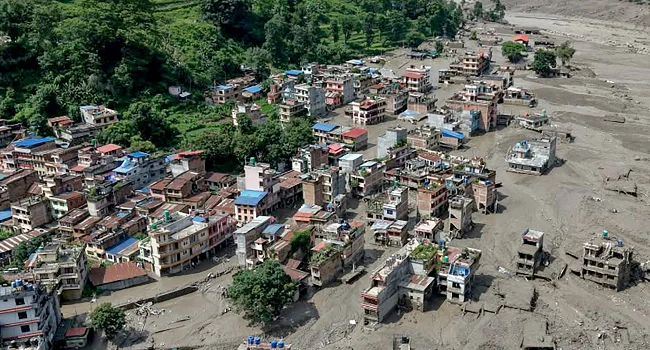
At least 165 people have been killed after devastating floods and landslides swept through communities along the Nepal-Tibet border, with experts warning that the region’s extreme terrain can turn sudden water releases into deadly disasters.
The exact cause of the disaster remains under investigation. Initial reports suggested that an earthquake triggered a landslide which blocked a river before the barrier eventually collapsed, sending a powerful surge of water and mud downstream.
However, the United States Geological Survey later said its analysis pointed to a different cause. The agency said additional examination of long-period seismic waves indicated that the seismic energy came from a glacial collapse and debris flow, rather than an earthquake.
The disaster sent huge volumes of mud and water through nearby communities, sweeping away buildings, vehicles and entire villages. Videos from the affected areas showed residents confronting a rapidly moving wall of debris with little time to escape.
Researchers say the Himalayas are particularly exposed to hazards linked to rising temperatures. Dorothy Heinrich, a researcher at the University of Reading in the UK, said climate change is contributing to conditions such as glacial retreat and permafrost reduction, which can increase the risk of landslides and glacial lake outburst floods.
A glacial lake outburst flood, or GLOF, occurs when water held behind a glacier-fed lake is suddenly released. Scientists, however, caution that establishing whether climate change directly caused a specific disaster requires detailed attribution studies comparing present-day climate conditions with those before significant human-driven warming.
A preliminary assessment by the International Centre for Integrated Mountain Development (ICIMOD) found no unusual activity on the Chinese side of the border. Sarthak Shrestha, a remote sensing and geoinformation analyst at the organisation, said a rock-ice avalanche may have occurred in Nepal, blocking the Lhende River and triggering the cascading flood.
The absence of significant rainfall before the disaster has also raised concerns about the effectiveness of conventional flood warning systems. Hydrologist Hatim Sharif of the University of Texas at San Antonio said sudden mudflows can leave people with almost no time to react, describing the mixture of water and debris as similar to “liquid concrete.” He advised people caught in such situations to seek higher ground rather than attempting to escape by running or driving.
Experts have suggested installing river-level monitoring systems capable of transmitting real-time changes to authorities. Such technology could potentially provide communities with 20 to 30 minutes of warning in some situations. Meanwhile, ICIMOD climate and environmental risks expert Qianggong Zhang has warned that another flood could occur if an upstream blockage remains.
The latest disaster has renewed attention on the growing risks facing communities in the Himalayas, where glaciers, unstable slopes and river systems interact in a landscape highly vulnerable to sudden environmental changes.